

Introduction
Investing can feel intimidating when you are just starting out. You hear people talk about stocks, ETFs, index funds, brokerage accounts, Roth IRAs, dividends, market crashes, and compound growth—and suddenly it feels easier to do nothing.
But here is the truth: you do not need to be rich to start investing. You do not need thousands of dollars. You do not need to understand every Wall Street term. You do not even need to pick individual stocks.
In 2026, you can start investing with as little as $100. In some brokerage accounts, you can start with even less because fractional shares allow you to buy small portions of expensive investments. The most important step is not investing a huge amount at the beginning—it is building the habit of investing consistently.
Investing is how ordinary people build long-term wealth. Saving protects your money. Investing helps it grow. A savings account is ideal for emergencies and short-term goals, but if your goal is retirement, financial independence, or long-term wealth, investing is usually necessary because your money needs the opportunity to outpace inflation over time.
In this beginner-friendly guide, you will learn exactly how to start investing with $100. We will cover what investing really means, what to do before you invest, which account to choose, what beginner investments make sense, how to avoid common mistakes, and how to build a simple long-term plan.
This article is educational, not personal financial advice. But by the end, you will have a clear roadmap for taking your first confident step into Investing for Beginners
What Is Investing?
Investing means putting money into assets that have the potential to grow in value or generate income over time. These assets may include stocks, bonds, mutual funds, exchange-traded funds, real estate, or retirement accounts that hold those investments.
The goal of investing is not to get rich overnight. The goal is to build wealth gradually through time, growth, compounding, and consistency.
Saving vs. Investing
Saving and investing are both important, but they serve different purposes.
Saving is for money you need to keep safe and accessible. This includes your emergency fund, rent money, short-term goals, and cash you may need within the next few months or years.
Investing is for long-term goals. This includes retirement, wealth building, college savings, and financial independence. Investments can rise and fall in value, so you should generally avoid investing money you may need soon.
If you have not built your emergency fund yet, start with our guide on 1. Investing before having a cash cushion can backfire if an unexpected expense forces you to sell investments at the wrong time.
What to Do Before You Start Investing
Before you put your first $100 into the market, make sure your financial foundation is stable. Investing is powerful, but it should not come before basic financial security.
Build a Starter Emergency Fund
At minimum, try to save $500 to $1,000 before investing aggressively. This small cushion helps you avoid using credit cards when life happens. Once you have that starter fund, you can decide whether to invest a small amount while continuing to build your full emergency fund.
For emergency savings, a high-yield savings account or money market account is usually better than an investment account because your money stays safe and liquid. You can compare options in our guides on 1 and 1.
Pay Attention to High-Interest Debt
If you have credit card debt charging 20% or more, paying it down may give you a better guaranteed return than investing. That does not mean you can never invest while in debt, but high-interest debt should be a priority.
If this applies to you, read our guide on 1 before putting large amounts into the market.
Create a Monthly Budget
Investing works best when it becomes part of your monthly plan. If you are investing randomly with leftover money, you may not stay consistent. A budget helps you decide how much you can invest without hurting your bills, savings, or debt payoff.
Two beginner-friendly options are the 1 and 1. The first is simpler; the second gives you more control.
Can You Really Start Investing With $100?
Yes, you can absolutely start investing with $100. In the past, many investments required large minimums, but beginner investors now have far more access.
Why $100 Is Enough to Begin
Starting with $100 teaches you how investing works without risking a large amount. You learn how to open an account, place an order, read your dashboard, understand market movement, and handle emotional ups and downs.
The point of your first $100 is not to become rich. The point is to start.
A $100 investment becomes powerful when it turns into a habit. If you invest $100 once, it is a good start. If you invest $100 every month for years, you are building a wealth-building system.
The Power of Consistency
Many beginners wait because they think they need $1,000, $5,000, or $10,000 to begin. But waiting has a cost. Investing is heavily influenced by time. The earlier you start, the more time your money has to compound.
Even small amounts matter when they are invested regularly. This is why the habit is more important than the starting amount.
Step 1: Decide Your Investing Goal
Before choosing an account or investment, ask yourself: Why am I investing?
Your goal determines your account type, investment choice, and risk level.
Common Investing Goals
You might be investing for:
- Retirement
- Financial independence
- A house down payment in 10+ years
- A child’s future education
- Long-term wealth
- Passive income
- Learning how the market works
If your goal is less than three years away, investing may not be the best place for that money because markets can drop suddenly. For short-term goals, savings accounts are usually safer.
If your goal is 10, 20, or 30 years away, investing becomes more appropriate because you have time to ride out market volatility.
Step 2: Choose the Right Investment Account
Your investment account is the container that holds your investments. Choosing the right account matters.
Option 1: Brokerage Account
A taxable brokerage account is flexible. You can invest in stocks, ETFs, mutual funds, and other assets. You can withdraw money at any time, though you may owe taxes on gains.
This is a good option if you want flexibility or are investing for goals other than retirement.
Option 2: Roth IRA
A Roth IRA is a retirement account funded with after-tax money. Your investments can grow tax-free, and qualified withdrawals in retirement are tax-free.
For 2026, the IRS says total annual contributions to traditional and Roth IRAs are limited to $7,500, with an additional $1,100 catch-up contribution for people age 50 and older. Roth IRA eligibility may also be limited based on filing status and income. 2
A Roth IRA is often excellent for beginners investing for retirement, especially if they expect to be in a higher tax bracket later.
Option 3: Traditional IRA
A traditional IRA may allow tax-deductible contributions depending on your income and workplace retirement plan coverage. Taxes are generally paid when you withdraw money in retirement.
This can be useful if you want a potential tax deduction now, but beginners should compare it carefully with a Roth IRA.
Option 4: Employer 401(k)
If your employer offers a 401(k), especially with a company match, this may be one of the best places to start. A match is essentially free money from your employer.
If you can only invest a small amount, try to contribute enough to get the full match before investing elsewhere.
Step 3: Understand Beginner-Friendly Investments
Now that you know the account types, let’s talk about what you can invest in.
Stocks
A stock represents ownership in a company. If the company grows, your shares may rise in value. Some stocks also pay dividends.
Individual stocks can be exciting, but they are risky for beginners because one company can perform poorly, cut its dividend, or even fail. If you are new, avoid putting your entire $100 into one random stock because you saw someone recommend it online.
Bonds
Bonds are loans made to governments or companies. In exchange, you receive interest payments. Bonds are generally less volatile than stocks but also usually have lower long-term growth potential.
Bonds can help balance a portfolio, especially for conservative investors or people closer to retirement.
Mutual Funds
A mutual fund pools money from many investors and invests in a collection of stocks, bonds, or other assets. This allows beginners to own many investments through one fund. The SEC’s Investor.gov explains that mutual funds and ETFs pool investor money and may provide diversification, but investors should read a fund’s prospectus and understand what it actually holds. 3
ETFs
An exchange-traded fund, or ETF, is similar to a mutual fund but trades on an exchange like a stock. ETFs are popular with beginner investors because many offer broad diversification, low expense ratios, and no large minimum investment when purchased through a brokerage.
Index Funds
Index funds are mutual funds or ETFs that track a market index, such as the S&P 500 or total U.S. stock market. Instead of trying to beat the market, they aim to match the market.
For many beginners, broad-market index funds are a simple, low-cost way to start.
Step 4: Consider a Simple Beginner Portfolio
A beginner portfolio does not need to be complicated. In fact, simpler is often better.
The One-Fund Approach
With $100, you could start with a single broad-market index ETF or mutual fund. This gives you exposure to many companies through one investment.
Examples of broad categories include:
- Total U.S. stock market fund
- S&P 500 index fund
- Total world stock market fund
- Target-date retirement fund
This is not a recommendation to buy a specific fund. Instead, it is a framework: choose broad, diversified, low-cost investments rather than trying to pick hot stocks.
The Two-Fund Approach
If you want slightly more balance, you might use:
- One stock index fund
- One bond index fund
For a young investor with a long timeline, the stock portion may be larger. For someone more cautious or closer to needing the money, the bond portion may be larger.
The Target-Date Fund Approach
A target-date fund is designed for retirement investors. You choose a fund with a year close to your expected retirement date, and the fund automatically adjusts its mix of stocks and bonds over time.
This can be convenient for beginners who want a hands-off approach.
Step 5: Use Dollar-Cost Averaging
Dollar-cost averaging means investing a fixed amount at regular intervals, regardless of whether the market is up or down.
For example, you might invest:
- $25 per week
- $50 every two weeks
- $100 per month
When prices are high, your fixed amount buys fewer shares. When prices are low, it buys more shares. FINRA explains that dollar-cost averaging means regularly buying a fixed dollar amount, which results in buying more shares when prices are lower and fewer when prices are higher, though investors may give up potentially higher returns compared with investing a lump sum immediately. 4
Why This Helps Beginners
Dollar-cost averaging is useful because it reduces the pressure to “time the market.” You do not need to guess whether today is the perfect day to invest. You simply follow your schedule.
This is especially helpful emotionally. When the market drops, you are not panicking—you are buying more shares at lower prices.
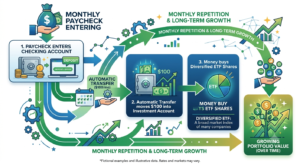
Step 6: Automate Your Investing
Automation turns investing from a decision into a habit.
Set up a recurring transfer from your checking account to your investment account. Then set up automatic investing if your brokerage allows it.
For example:
- $25 weekly
- $50 biweekly
- $100 monthly
- 10% of every paycheck
The amount matters less than consistency. If $100 per month is too much, start with $25. You can increase later.
Our guide on 1 explains how to create systems so your savings, bills, and investments run automatically.
Step 7: Understand Risk Before You Invest
Investing always involves risk. Your balance will rise and fall. Some years may be excellent. Some years may be negative.
Market Risk
Stock market investments can lose value, especially in the short term. This is normal. If you invest for long-term goals, volatility is part of the process.
Concentration Risk
Putting all your money into one stock, one cryptocurrency, or one trend creates concentration risk. If that one investment performs badly, your whole portfolio suffers.
Diversification helps reduce this risk by spreading your money across many investments. The SEC explains that asset allocation and diversification involve spreading investments among different asset categories, but diversification does not guarantee a profit or protect fully against loss. 5
Emotional Risk
Many beginners lose money not because they choose terrible investments, but because they panic. They buy when everyone is excited and sell when everyone is scared.
Your job is to build a plan before emotions take over.
Step 8: Avoid Beginner Investing Mistakes
Learning what not to do can save you years of frustration.
Mistake 1: Waiting Too Long to Start
You do not need perfect knowledge to start. You need basic understanding, a safe platform, and a simple plan.
Mistake 2: Trying to Get Rich Quickly
Investing is not gambling. Avoid hype-driven decisions, meme stocks, “guaranteed returns,” and influencers promising easy wealth.
Mistake 3: Ignoring Fees
Fees reduce your returns. Pay attention to expense ratios, transaction fees, advisory fees, and account fees. Even small fees matter over decades.
Mistake 4: Investing Emergency Money
Do not invest rent money, grocery money, or emergency savings. Keep short-term money safe.
Mistake 5: Checking Your Account Too Often
If you check your account every day, normal market movement can feel stressful. Long-term investors do not need daily updates.
Mistake 6: Selling During Market Drops
Market downturns are uncomfortable, but selling in panic can lock in losses. If your goal is decades away, a drop may be an opportunity to keep buying at lower prices.
What About Investing Apps and Robo-Advisors?
Many beginners use investing apps or robo-advisors because they simplify the process.
Investing Apps
Brokerage apps allow you to buy stocks, ETFs, and other investments from your phone. They are convenient, but convenience can become dangerous if it encourages frequent trading.
Use apps as tools, not entertainment.
Robo-Advisors
A robo-advisor builds and manages a portfolio for you based on your goals and risk tolerance. It may automatically rebalance your investments and reinvest dividends.
This can be helpful if you want a hands-off approach. We will cover this topic more deeply in our upcoming guide on 1.
Account Protection
Brokerage accounts are different from bank accounts. FDIC insurance covers bank deposits, while brokerage accounts may be protected by SIPC if a SIPC-member brokerage fails. SIPC protection can cover up to $500,000, including a $250,000 limit for cash, but it does not protect you from investment losses when the market goes down. 6
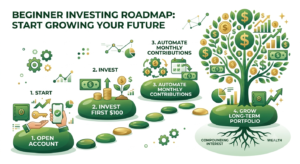
A Simple $100 Beginner Investing Plan
Here is a practical example of how someone might start investing with $100.
Month 1: Learn and Open an Account
- Read beginner investing basics
- Check your emergency fund
- Choose a brokerage, Roth IRA, or 401(k)
- Open the account
- Deposit your first $100
Month 2: Choose a Simple Investment
- Pick a broad, diversified, low-cost fund
- Avoid chasing individual stock tips
- Learn how to place a buy order
- Write down why you chose the investment
Month 3: Automate Contributions
- Set up a recurring deposit
- Start with $25, $50, or $100 monthly
- Increase when your income grows
Month 4 and Beyond: Stay Consistent
- Review quarterly, not daily
- Rebalance if needed
- Increase contributions over time
- Keep learning
The plan is simple because beginners do better with clarity than complexity.
 ”
”
How Much Should Beginners Invest Each Month?
There is no perfect number. Start with what you can afford consistently.
Beginner Contribution Ideas
- $25 per month if money is tight
- $50 per month if you are building the habit
- $100 per month if your budget allows
- 10% to 15% of income for long-term retirement goals
- More if you are pursuing financial independence
If you want to find more room in your budget, start with 1. If you want extra income to invest, read our guide on 1.
Frequently Asked Questions
Is $100 enough to start investing?
Yes. $100 is enough to open many beginner-friendly investment accounts and buy fractional shares or ETFs. The amount is less important than building the habit of investing consistently over time.
What is the best investment for beginners?
Many beginners start with broad, low-cost index funds or ETFs because they provide diversification without requiring you to pick individual stocks. Target-date retirement funds can also be useful for hands-off retirement investing.
Should I invest if I have credit card debt?
If you have high-interest credit card debt, paying it down should usually be a priority because the interest rate may be higher than what you can reasonably expect from investments. A small starter investment may be fine for learning, but avoid investing aggressively while expensive debt grows.
Is investing risky?
Yes, investing involves risk. Stocks, ETFs, mutual funds, and other investments can lose value. The key is to match your investments with your time horizon, diversify, avoid panic selling, and never invest money you need soon.
Should I use a Roth IRA or brokerage account?
If your goal is retirement and you qualify, a Roth IRA can be attractive because qualified withdrawals in retirement may be tax-free. If your goal is flexibility before retirement, a taxable brokerage account may be better.
How often should I check my investments?
For long-term investing, checking monthly or quarterly is usually enough. Checking daily can increase stress and tempt you to make emotional decisions.
here some ideas
https://finance4you.online/index-funds-vs-etfs/
https://finance4you.online/best-robo-advisors-2026/
https://finance4you.online/cryptocurrency-investing-guide-2026/
https://finance4you.online/sustainable-investing-esg-funds-guide/
Conclusion: Your First $100 Is the Beginning, Not the Finish Line
Investing for beginners does not need to be complicated. You do not need a finance degree, a huge paycheck, or perfect timing. You need a clear goal, a stable financial foundation, a simple account, and the willingness to start.
Your first $100 will not make you wealthy overnight. But it can change your mindset. It proves that investing is not just for rich people. It shows you how the process works. Most importantly, it begins the habit that can grow into real wealth over years and decades.
Start small. Choose a diversified, low-cost investment. Automate contributions. Avoid hype. Keep learning. Stay patient.
The best investors are not always the smartest people in the room. Often, they are the most consistent.
Ready to build your investing foundation? Start by making sure your cash safety net is strong with 1, keep your savings in one of the 1, free up money using the 1 or 1, and use 1 to make investing a habit. Next, compare 1 to choose the right beginner-friendly investment structure.
Your wealth-building journey can begin with one simple step: invest your first $100.
Disclaimer: This article is for informational and educational purposes only and does not constitute financial, investment, tax, or legal advice. Investing involves risk, including possible loss of principal. Consider consulting a qualified financial advisor before making investment decisions.