


Introduction
Few investment topics generate as much excitement, confusion, and controversy as cryptocurrency. To some, crypto represents the future of money and a revolutionary technology. To others, it is a speculative bubble filled with risk and uncertainty. The truth, as usual, lies somewhere in between.
Cryptocurrency has evolved significantly since Bitcoin launched in 2009. What started as an obscure digital experiment has grown into a multi-trillion-dollar asset class that has captured mainstream attention. Major financial institutions now offer crypto services. Some countries have adopted Bitcoin as legal tender. Blockchain technology continues to find new applications beyond currency.
But alongside this growth comes significant risk. Cryptocurrency markets are notoriously volatile. Prices can swing 20%, 30%, or even 50% in a matter of days or weeks. Regulatory uncertainty remains high. Security breaches and scams are common. Many cryptocurrencies have failed completely, taking investor money with them.
So should you invest in cryptocurrency? And if so, how should you approach it responsibly?
This guide will not tell you whether to buy Bitcoin or promise that crypto will make you rich. Instead, it will give you the educational foundation you need to make informed decisions. You will learn what cryptocurrency actually is, how blockchain technology works, the major types of crypto assets, the real risks involved, how to invest if you choose to, tax considerations, and how crypto might fit—or not fit—into a balanced investment strategy.
By the end, you will understand cryptocurrency well enough to decide for yourself whether it belongs in your portfolio and, if so, how to approach it intelligently. also read https://finance4you.online/sustainable-investing-esg-funds-guide/
Let’s start with the basics of Cryptocurrency Investing guide 2026.
What Is Cryptocurrency?
Cryptocurrency is digital or virtual currency that uses cryptography for security and operates on decentralized networks based on blockchain technology. Unlike traditional currencies issued by governments (like dollars or euros), most cryptocurrencies are not controlled by any central authority.
Understanding Blockchain Technology
At its core, cryptocurrency relies on blockchain—a distributed digital ledger that records transactions across many computers. Once a transaction is recorded, it cannot be altered retroactively without changing all subsequent blocks, making the system secure and transparent.
Think of blockchain as a shared spreadsheet that thousands of computers maintain simultaneously. When someone wants to add a new transaction, the network must verify and agree on it. Once verified, the transaction is permanently recorded and visible to everyone.
This decentralized structure eliminates the need for traditional intermediaries like banks or payment processors. Transactions can happen directly between parties, theoretically making transfers faster, cheaper, and more accessible globally.
How Cryptocurrency Works
When you “own” cryptocurrency, you do not actually hold physical coins. Instead, you own cryptographic keys—essentially complex passwords—that give you access to your portion of the blockchain. Your private key proves ownership and allows you to authorize transactions.
Cryptocurrency can be:
- Sent from one digital wallet to another
- Received as payment for goods, services, or as a transfer
- Stored in digital wallets (software or hardware)
- Traded on cryptocurrency exchanges for other crypto or traditional currency
- Used for purchases at businesses that accept it
The system operates 24/7 globally, unlike traditional markets with set hours.
Major Types of Cryptocurrency
Thousands of cryptocurrencies exist, but they fall into several broad categories.
Bitcoin (BTC)
Bitcoin was the first cryptocurrency, created in 2009 by an anonymous person or group using the name Satoshi Nakamoto. It remains the largest cryptocurrency by market value and is often called “digital gold” because many view it as a store of value rather than a currency for everyday transactions.
Bitcoin has a fixed supply cap of 21 million coins, creating scarcity similar to precious metals. This limited supply is central to its value proposition.
Ethereum (ETH)
Ethereum is both a cryptocurrency and a blockchain platform that allows developers to build decentralized applications and “smart contracts”—self-executing agreements written in code. While Bitcoin focuses on being digital currency, Ethereum enables programmable blockchain technology.
Many other cryptocurrencies and blockchain projects are built on top of the Ethereum network.
Stablecoins
Stablecoins are cryptocurrencies designed to maintain a stable value by pegging themselves to traditional assets like the U.S. dollar. Examples include Tether (USDT) and USD Coin (USDC), which theoretically always equal $1.
Stablecoins aim to combine blockchain technology’s benefits with traditional currency’s price stability. However, the mechanisms maintaining this stability vary and sometimes fail, as seen in past stablecoin collapses.
Altcoins
“Altcoin” is a catch-all term for any cryptocurrency other than Bitcoin. This includes thousands of projects with varying purposes:
- Payment coins focused on transactions
- Privacy coins emphasizing anonymous transactions
- Platform tokens powering specific blockchain ecosystems
- Utility tokens providing access to services
- Meme coins created as jokes or for communities
Many altcoins serve legitimate purposes. Many others are speculative projects with little real-world utility.

The Case for Cryptocurrency Investment
Before discussing risks, let’s understand why some investors choose to include cryptocurrency in their portfolios.
Potential for High Returns
Cryptocurrency has generated extraordinary returns for early adopters. Bitcoin has risen from pennies to tens of thousands of dollars. Other cryptocurrencies have seen similar explosive growth, though many have also crashed to zero.
This potential for outsized gains attracts investors willing to accept high risk for the possibility of high reward.
Diversification
Some investors view cryptocurrency as a way to diversify beyond traditional stocks and bonds. Because crypto often moves independently of traditional markets, it may provide portfolio diversification benefits—though this relationship is debated and has varied over time.
Inflation Hedge
Bitcoin’s fixed supply appeals to investors concerned about currency devaluation and inflation. Unlike government-issued currency that can be printed without limit, Bitcoin’s supply is mathematically capped at 21 million coins.
Whether Bitcoin actually functions as an effective inflation hedge remains hotly debated, with mixed evidence so far.
Technology Belief
Many cryptocurrency investors believe blockchain technology will fundamentally change finance, contracts, ownership verification, and digital identity. Investing in crypto is, to them, a bet on this technological transformation.
Accessibility and Decentralization
Cryptocurrency can provide financial access to people without traditional banking infrastructure. It operates globally, 24/7, with no central authority controlling who can participate.
For investors concerned about centralized financial control, cryptocurrency offers an alternative vision.
The Case Against Cryptocurrency Investment
Now let’s examine the significant risks and criticisms surrounding cryptocurrency.
Extreme Volatility
Cryptocurrency prices can swing wildly in short periods. A 20% daily move is not uncommon. Bitcoin has experienced multiple drawdowns of 50% to 80% from peak prices. Most altcoins are even more volatile.
This volatility makes cryptocurrency unsuitable for money you need in the near term or cannot afford to lose entirely.
Regulatory Uncertainty
Governments worldwide are still determining how to regulate cryptocurrency. New regulations could significantly impact crypto’s value, usability, and legality. Some countries have banned cryptocurrency entirely. Others are creating frameworks that may restrict or tax it heavily.
This regulatory risk adds another layer of uncertainty to an already volatile asset class.
Security Risks
Cryptocurrency security depends on properly managing private keys. If you lose your keys, you lose access to your crypto permanently—there is no customer service to call for password resets. If someone steals your keys, your crypto is gone with virtually no recourse.
Cryptocurrency exchanges have been hacked, frozen, or shut down, sometimes taking customer funds with them. The FDIC insurance that protects bank deposits does not apply to cryptocurrency held on exchanges or in wallets.
Limited Real-World Use
Despite years of development, cryptocurrency remains limited in real-world payment use. Few merchants accept crypto. Transaction fees and speed issues have plagued some networks. For most people, traditional payment methods remain far more practical.
This raises questions about cryptocurrency’s fundamental value if it is not widely used as intended.
Environmental Concerns
Some cryptocurrencies, particularly Bitcoin, use energy-intensive “proof of work” mining systems. Critics argue this contributes significantly to climate change. Ethereum transitioned to a more energy-efficient system, but environmental concerns persist for many cryptocurrencies.
Scams and Fraud
The cryptocurrency space has attracted numerous scams, from fake coins to pyramid schemes to celebrity-endorsed projects that crashed. Pump-and-dump schemes are common. New investors often lack the expertise to distinguish legitimate projects from fraudulent ones.
The SEC warns that fraudsters use social media, messaging apps, and online advertising to promote fraudulent crypto investment schemes and that investors should be cautious of promises of guaranteed high returns and pressure tactics. https://finance4you.online/sustainable-investing-esg-funds-guide/
How to Invest in Cryptocurrency (If You Choose To)
If you decide cryptocurrency fits your risk tolerance and investment strategy, here is how to approach it responsibly.
Step 1: Understand Your Risk Tolerance
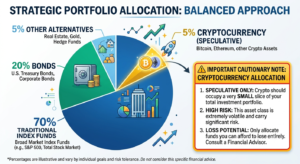
Cryptocurrency should only represent a small portion of a well-diversified portfolio for most investors. Many financial advisors suggest limiting crypto exposure to 5% or less of total investments, treating it as a high-risk, speculative position.
Never invest money you cannot afford to lose completely. Cryptocurrency is not appropriate for emergency funds, short-term savings, or essential financial goals.
Before investing in any high-risk asset, ensure you have built your financial foundation with an emergency fund. Our guide on explains this critical first step.
Step 2: Choose a Reputable Exchange
To buy cryptocurrency, you need to use a cryptocurrency exchange. Major U.S.-based exchanges include:
- Coinbase
- Kraken
- Gemini
- Binance.US
Choose an exchange that:
- Is regulated and licensed in your jurisdiction
- Has strong security measures including two-factor authentication
- Offers the cryptocurrencies you want to buy
- Has reasonable fees
- Provides clear tax reporting documents
Avoid exchanges with poor security track records, limited regulatory compliance, or questionable reputations.
Step 3: Set Up Secure Storage
Cryptocurrency can be stored in several ways:
Exchange Wallets:
Keeping crypto on the exchange where you bought it is convenient but risky. If the exchange is hacked or fails, you may lose access to your funds.
Software Wallets:
Digital wallets on your computer or phone give you control of your private keys. They are more secure than exchange storage but still vulnerable to device hacking or loss.
Hardware Wallets:
Physical devices that store your private keys offline provide the highest security for larger holdings. Popular options include Ledger and Trezor devices.
The appropriate storage method depends on the amount you hold and how often you trade. For significant holdings you plan to keep long-term, hardware wallets offer the best security.
Step 4: Start Small and Dollar-Cost Average
Instead of investing a large lump sum, consider dollar-cost averaging—investing a fixed amount at regular intervals. This approach reduces the risk of buying at a peak price and can smooth out volatility.
For example, investing $50 or $100 per month exposes you to various price points over time, potentially lowering your average cost per coin.
Dollar-cost averaging does not guarantee profits or protect against losses, but it removes the pressure of trying to time the market perfectly.
Step 5: Diversify Within Crypto (Maybe)
If you choose to invest in cryptocurrency, consider whether to hold only Bitcoin, or also include Ethereum and possibly other established projects.
Concentration in a single cryptocurrency increases risk. However, diversifying into numerous small altcoins also increases risk because most may ultimately fail. There is no perfect answer—just different risk profiles.
Step 6: Never Invest Based on Hype
Avoid investing in cryptocurrency because:
- A celebrity endorsed it
- Your friend said it will “moon”
- You fear missing out on gains
- Social media is buzzing about it
- Someone promised guaranteed returns
These are red flags, not investment strategies. The SEC specifically warns against investment opportunities promoted through social media, especially those promising guaranteed high returns.

Cryptocurrency Taxes: What You Must Know
Cryptocurrency taxation is complex and strictly enforced. The IRS treats cryptocurrency as property, not currency, which has significant tax implications.
Taxable Events
You may owe taxes when you:
- Sell cryptocurrency for cash
- Trade one cryptocurrency for another
- Use cryptocurrency to buy goods or services
- Receive cryptocurrency as payment for work
- Earn cryptocurrency through staking or mining
Simply buying and holding cryptocurrency does not trigger taxes. But nearly everything else does.
Capital Gains and Losses
When you sell cryptocurrency for more than you paid, you realize a capital gain and owe taxes. How much tax depends on how long you held the asset:
- Short-term capital gains (held less than one year): taxed as ordinary income at your regular tax rate
- Long-term capital gains (held over one year): taxed at lower capital gains rates (0%, 15%, or 20% depending on income)
When you sell for less than you paid, you realize a capital loss, which can offset other gains and potentially reduce your tax bill.
Record Keeping Is Critical
You must track:
- Date and price of each purchase
- Date and price of each sale
- Purpose of each transaction
- Gains or losses for each taxable event
Many exchanges provide transaction history, but you remain responsible for accurate reporting. Tax software for cryptocurrency like Coin Tracker or Zen Ledger can help, but the responsibility is ultimately yours.
The IRS has made cryptocurrency tax compliance a priority, and failure to report can result in penalties, interest, and potential criminal charges in extreme cases.
Common Cryptocurrency Mistakes Beginners Make
Avoid these costly errors that plague new crypto investors.
Mistake 1: Investing More Than You Can Afford to Lose
Cryptocurrency is highly speculative. Some investors have lost everything. Never invest emergency funds, rent money, or money earmarked for essential expenses.
Mistake 2: Leaving Large Amounts on Exchanges
Exchanges are targets for hackers. If you hold significant cryptocurrency long-term, move it to a secure wallet you control. The phrase “not your keys, not your crypto” captures this principle.
Mistake 3: Forgetting Your Passwords or Seed Phrases
If you lose your private keys or seed phrase (the backup phrase that restores access to your wallet), your cryptocurrency is gone forever. No customer service can recover it. Write down your seed phrase and store it securely.
Mistake 4: Chasing Pumps and Panicking During Dumps
Buying after a massive price spike (FOMO) and selling after a crash (panic) is a recipe for losses. Emotional trading rarely works in cryptocurrency’s volatile environment.
Mistake 5: Ignoring Fees
Transaction fees, exchange fees, and network fees can add up quickly, especially for small transactions. Understand all costs before investing.
Mistake 6: Believing It Cannot Fail
Many cryptocurrencies have gone to zero. Even Bitcoin and Ethereum, while established, are not guaranteed to succeed. Technology can be disrupted, regulations can change, and better alternatives may emerge.
Mistake 7: Not Understanding What You Own
If you cannot explain in simple terms what a cryptocurrency does or why it has value, you probably should not invest in it. Understanding your investments is fundamental.
Cryptocurrency in a Balanced Portfolio
How does cryptocurrency fit into a sensible long-term investment strategy?
Most Wealth Should Be in Traditional Assets
For most investors, the core of their portfolio should remain in proven, diversified investments like:
- Low-cost index funds tracking stock markets
- Bond funds for stability
- Real estate (through REITs or direct ownership)
- Cash reserves for emergencies
These traditional assets have decades of performance data, regulatory clarity, and predictable behavior. If you are just starting to invest, our guide on explains how to build this foundation.
Crypto as a Small Speculative Position
If cryptocurrency appeals to you and you accept the risks, consider treating it as a small, speculative allocation—perhaps 1% to 5% of your total investment portfolio.
This approach allows you to participate in potential upside without exposing your entire financial future to extreme volatility and uncertainty.
Rebalancing Considerations
If cryptocurrency grows to represent a larger percentage of your portfolio than intended, consider rebalancing by selling some and redirecting proceeds to traditional investments. This locks in gains and maintains your intended risk level.
Similarly, if crypto crashes and becomes a smaller percentage, you might choose to add more to return to your target allocation—or simply let it remain small.
Alternatives to Direct Cryptocurrency Investment
If you are interested in blockchain technology but uncomfortable with direct cryptocurrency ownership, alternatives exist.
Cryptocurrency ETFs
Some exchange-traded funds provide exposure to cryptocurrency prices without requiring you to buy, store, or secure crypto directly. These ETFs hold Bitcoin or other cryptocurrencies on your behalf.
The advantage is simplicity and traditional brokerage account access. The disadvantage is fees and tracking error—the ETF’s performance may not perfectly match the underlying crypto.
Blockchain Technology Stocks
You can invest in companies involved in blockchain technology without owning cryptocurrency itself. These include:
- Cryptocurrency exchanges (like Coinbase)
- Payment companies integrating crypto
- Technology companies developing blockchain solutions
- Mining companies
This approach provides exposure to the blockchain ecosystem with the relative familiarity of stock investing.
Crypto Exposure Through Funds
Some mutual funds and hedge funds include cryptocurrency exposure as part of broader portfolios. This provides indirect exposure managed by professionals, though typically with higher fees.
The Future of Cryptocurrency: Realistic Expectations
Predicting cryptocurrency’s future is impossible, but understanding potential scenarios helps set realistic expectations.
Possible Outcomes
Mainstream adoption:
Cryptocurrency could become widely used for payments, smart contracts, and financial services, driving long-term value growth.
Niche asset class:
Crypto might remain a specialized investment and technology but never achieve mass adoption.
Regulatory suppression:
Governments could heavily regulate or restrict cryptocurrency, limiting its growth and use.
Technology evolution:
Better alternatives could replace current cryptocurrencies, rendering today’s options obsolete.
Continued volatility:
Crypto might remain highly volatile but persist as a speculative asset class alongside traditional investments.
All of these outcomes—and others—remain possible. Anyone claiming certainty about cryptocurrency’s future should be viewed with skepticism.
What Experts Generally Agree On
Most mainstream financial experts agree that:
- Cryptocurrency is high-risk and should represent only a small portfolio allocation
- Blockchain technology has legitimate applications beyond speculation
- Regulatory clarity will eventually emerge, though its form is uncertain
- Volatility will likely persist for the foreseeable future
- Most individual cryptocurrencies will probably fail
- Some form of digital assets may be part of the future financial system
- https://finance4you.online/best-robo-advisors-2026/
Frequently Asked Questions
Should I invest in cryptocurrency?
That depends entirely on your financial situation, risk tolerance, and goals. Cryptocurrency is appropriate only for money you can afford to lose completely, and only after you have built a solid financial foundation with emergency savings and diversified traditional investments. For most people, crypto should be a small speculative position at most, not a core holding.
Is Bitcoin a good investment in 2026?
No one can predict whether Bitcoin will rise or fall. It has experienced both extraordinary gains and painful crashes. Bitcoin remains the most established cryptocurrency, but that does not guarantee future performance. Only invest amounts you can afford to lose, and understand the extreme volatility involved.
How much of my portfolio should be in cryptocurrency?
Most financial advisors suggest 5% or less for investors who choose to include crypto at all. Many recommend even smaller allocations like 1% to 3%. Cryptocurrency should never represent the majority or even a large minority of your investment portfolio due to its speculative nature and extreme risk.
Is cryptocurrency safer than stocks?
No, cryptocurrency is generally far riskier than diversified stock index funds. While stocks can be volatile, they represent ownership in real companies with earnings, assets, and regulatory oversight. Cryptocurrency prices are driven largely by speculation, have no intrinsic value backing, and face significant regulatory uncertainty.
How do I pay taxes on cryptocurrency?
The IRS treats cryptocurrency as property. You owe taxes on gains when you sell, trade, or use crypto. Keep detailed records of all transactions, including dates and prices. Report all taxable events on your tax return using Form 8949 and Schedule D. Consider using cryptocurrency tax software to track complex transactions.
Can I lose all my money in cryptocurrency?
Yes, absolutely. Many cryptocurrencies have gone to zero. Even established cryptocurrencies like Bitcoin can experience severe drawdowns of 50% to 80%. Exchanges can fail or be hacked. If you lose your private keys, your crypto is permanently gone. Never invest money you cannot afford to lose entirely.
Conclusion: Approach Cryptocurrency With Caution and Realism
Cryptocurrency represents an innovative technology with both genuine potential and extraordinary risk. It is neither the guaranteed path to riches some promoters claim nor the complete scam some critics suggest. The reality is far more nuanced.
If you choose to invest in cryptocurrency, do so with open eyes. Understand that you are taking on significant risk in exchange for the possibility—not the promise—of significant returns. Keep your allocation small. Use secure storage. Track your taxes meticulously. Avoid hype and FOMO. Never invest more than you can afford to lose completely.
For most investors, cryptocurrency should be a small speculative position within a broader portfolio anchored by proven, diversified traditional investments. Your financial foundation should be built on emergency savings, low-cost index funds, and appropriate retirement accounts—not volatile digital assets.
Cryptocurrency may have a future in the financial system. But that future is uncertain, highly speculative, and should not be the cornerstone of your personal wealth-building strategy.
Invest wisely, invest cautiously, and never let cryptocurrency gambling replace sound financial planning.
Ready to build a complete investment strategy? Start with our guide on , compare traditional options like , explore automated management with , and ensure your financial foundation is strong by reading and maintaining . Use or to free up money for consistent investing in proven assets before speculating on crypto.
Build wealth through proven strategies first. Only then consider whether a small cryptocurrency allocation makes sense for your unique situation.
Disclaimer: This article is for informational and educational purposes only and does not constitute financial, investment, tax, or legal advice. Cryptocurrency investing is highly speculative and risky. You can lose all invested money. The author and publisher are not responsible for investment decisions you make. Consider consulting a qualified financial advisor and tax professional before investing in cryptocurrency.