
Introduction
If you have spent any time researching beginner investing, you have probably encountered two terms that seem to appear everywhere: index funds and ETFs. Financial experts recommend them constantly. Beginner investing guides praise them. Retirement planners build portfolios around them. And for good reason—both are powerful tools for long-term wealth building.
But here is where the confusion starts: index funds and ETFs are often discussed as if they are completely different things, when in reality they have far more in common than most beginners realize. They both offer diversification, they both tend to have low costs, and they both provide exposure to broad market indexes without requiring you to pick individual stocks.
So what actually separates them? And more importantly, which one should you choose?
The honest answer is that for many investors, the practical difference is small. Both can work beautifully in a long-term portfolio. But there are meaningful distinctions in how they trade, how they are taxed, what minimums they require, and how flexible they are—and those differences matter depending on your situation.
In this guide, you will learn exactly what index funds and ETFs are, how they differ across every factor that matters, the pros and cons of each, and most importantly, how to decide which investment type fits your goals, budget, and investing style. Whether you are just starting with your first $100 or building a larger portfolio, you will have clarity by the end.
https://finance4you.online/side-hustle-ideas-2026/
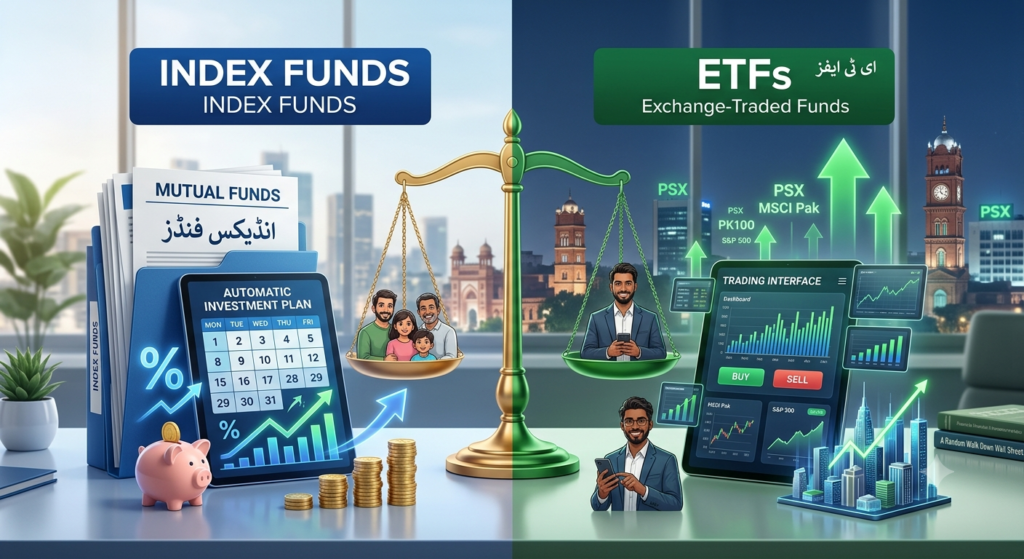
Let’s break Index Funds vs ETFs
What Is an Index Fund?
An index fund is a type of mutual fund designed to track a specific market index, such as the S&P 500, the total U.S. stock market, or international markets. Instead of trying to beat the market through active stock picking, index funds aim to match the performance of the index they follow.
How Index Funds Work
When you invest in an index fund, your money is pooled with money from thousands of other investors. The fund manager uses that pool to buy all—or a representative sample—of the stocks in the target index.
For example, an S&P 500 index fund holds shares in all 500 companies in the S&P 500 index. When the index rises, the fund rises. When the index falls, the fund falls. Your returns mirror the market.
Why Index Funds Became Popular
Index funds were created in the 1970s by John Bogle, the founder of Vanguard, who argued that most actively managed funds fail to beat the market after fees. Instead of paying high costs for managers who often underperform, investors could simply own the entire market at a much lower cost.
Decades of research have proven him right. The majority of actively managed funds underperform their benchmarks over long periods, making index funds an attractive choice for long-term investors.
Key Features of Index Funds
Index funds are:
- Passively managed — No active stock picking or frequent trading
- Broadly diversified — Own hundreds or thousands of stocks through one fund
- Low-cost — Expense ratios are typically much lower than actively managed funds
- Long-term focused — Designed for buy-and-hold investors
If you are new to investing, our guide on explains how index funds fit into a beginner portfolio.
What Is an ETF?
An ETF, or exchange-traded fund, is an investment fund that trades on a stock exchange just like an individual stock. Like index funds, many ETFs are designed to track market indexes, offering broad diversification and low costs.
How ETFs Work
ETFs hold a basket of securities—stocks, bonds, or other assets—and divide ownership into shares. You can buy and sell those shares throughout the trading day at market prices, just as you would buy shares of Apple or Tesla.
Most ETFs are passively managed index trackers, but some ETFs are actively managed. For this comparison, we are focusing on index-tracking ETFs since they compete directly with index mutual funds.
The Growth of ETFs
ETFs were introduced in the 1990s and have exploded in popularity. They combine the diversification benefits of mutual funds with the trading flexibility of stocks. By 2026, ETFs represent a massive portion of total investment assets, and they continue to grow.
Key Features of ETFs
ETFs are:
- Exchange-traded — Buy and sell during market hours like stocks
- Flexible — No investment minimums beyond the share price
- Tax-efficient — Often generate fewer taxable events than mutual funds
- Broadly diversified — Many ETFs track the same indexes as index funds
Both index funds and ETFs can serve as the foundation of a passive investing strategy, but the way they operate creates meaningful differences.
Index Funds vs ETFs: The Key Differences
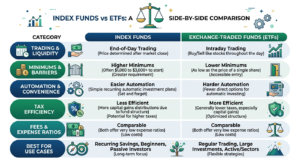
Now that you understand what each investment type is, let’s compare them across the factors that actually matter when choosing between them.
How They Trade
This is the most visible difference between index funds and ETFs.
Index Funds:
You buy and sell index fund shares directly from the fund company at the net asset value (NAV), which is calculated once per day after the market closes. Your order is executed at that end-of-day price, regardless of when during the day you placed it.
ETFs:
You buy and sell ETF shares on a stock exchange throughout the trading day. Prices fluctuate constantly based on supply and demand, just like individual stocks. You can place market orders, limit orders, and see real-time pricing.
Which is better?
For long-term buy-and-hold investors, this difference usually does not matter. You are not day trading—you are building wealth over decades. But if you value flexibility or want the ability to use advanced order types, ETFs offer more control.
Investment Minimums
Minimums can be a deciding factor for beginners with limited capital.
Index Funds:
Many index mutual funds require a minimum initial investment, typically ranging from $1,000 to $3,000. Some fund companies waive minimums if you set up automatic monthly investments, but the baseline can still be a barrier for new investors.
ETFs:
ETFs have no minimum beyond the price of one share. If an ETF costs $50 per share, you can start with $50. Many brokerages now offer fractional shares, meaning you can invest even less—sometimes as little as $1.
Which is better?
For beginners starting with small amounts like $100, ETFs are often more accessible. If you already have $1,000 or more and plan to invest through the fund company directly, index funds work fine.
Automatic Investing
Automation is critical for building consistent investing habits.
Index Funds:
Most fund companies make it easy to set up automatic recurring investments. You can schedule weekly, biweekly, or monthly transfers from your bank account, and the fund company automatically buys shares at the end-of-day NAV.
ETFs:
Automatic investing with ETFs is possible but less seamless. Some brokerages offer automatic ETF purchases, but the process may be slightly less straightforward than with index funds. You may need to ensure you have enough cash in your account to cover full or fractional shares.
Which is better?
If automation is a priority—and it should be—index funds traditionally have an edge, though the gap is narrowing as more brokerages improve their ETF automation features.
Our guide on explains how to set up systems that keep your investments growing without constant manual effort.
Expense Ratios and Fees
Both index funds and ETFs are known for low costs, but there are subtle differences.
Index Funds:
Index mutual funds charge an annual expense ratio, typically ranging from 0.03% to 0.20% for broad market index funds. Some ultra-low-cost funds charge even less. There are generally no trading commissions when buying directly from the fund company.
ETFs:
ETFs also charge expense ratios, often in the same range as comparable index funds (0.03% to 0.20%). Most major brokerages now offer commission-free ETF trading, but some brokerages may still charge fees depending on the ETF.
Which is better?
Expense ratios are comparable. The key is to choose low-cost options regardless of whether you pick an index fund or ETF. A 0.05% expense ratio is excellent for either type.
Tax Efficiency
Taxes matter, especially in taxable brokerage accounts.
Index Funds:
When other investors redeem shares from an index mutual fund, the fund may need to sell holdings to pay them, potentially triggering capital gains that are distributed to all shareholders—including you. This means you may owe taxes on gains even if you did not sell anything.
ETFs:
ETFs are generally more tax-efficient due to their unique structure. They use an “in-kind” creation and redemption process that minimizes taxable events. As a result, ETFs tend to distribute fewer capital gains to shareholders.
Which is better?
In taxable accounts, ETFs have a tax advantage. In tax-advantaged accounts like IRAs or 401(k)s, this difference does not matter because you are not paying taxes annually on gains.
Flexibility and Control
How much control do you want over when and how you buy?
Index Funds:
You place an order, and it executes at the end of the day. You cannot choose the exact price or time.
ETFs:
You can buy or sell at any time during market hours. You can use limit orders to set a maximum price, stop-loss orders to manage risk, or market orders for immediate execution.
Which is better?
For long-term investors, this flexibility rarely matters. But if you prefer more control or want to react to intraday market movements, ETFs offer that option.
https://finance4you.online/best-robo-advisors-2026/
Pros and Cons at a Glance
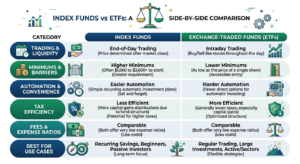
Let’s summarize the advantages and disadvantages of each investment type.
Index Fund Pros
- Easy to automate recurring investments
- Simple end-of-day pricing
- No need to worry about intraday price fluctuations
- Well-suited for retirement accounts
- Decades of proven performance
Index Fund Cons
- Often require minimum initial investments
- Less tax-efficient in taxable accounts
- Cannot trade during the day
- May have restrictions on how often you can trade
ETF Pros
- No investment minimums beyond share price
- More tax-efficient in taxable accounts
- Trade like stocks with real-time pricing
- Flexibility to use limit orders and advanced strategies
- Easier to start with small amounts
ETF Cons
- Intraday trading can tempt beginners to trade too often
- Automatic investing may be less seamless
- Bid-ask spreads can add small costs
- Requires a brokerage account
Which Should You Choose?
The answer depends on your situation, goals, and preferences. There is no universally “better” option—just the better option for you.
Choose Index Funds If…
You want the simplest possible investing experience with minimal decisions. Index funds through a fund company are straightforward and beginner-friendly.
You plan to automate monthly investments and prefer a hands-off approach. Index funds make recurring contributions seamless.
You are investing primarily in tax-advantaged accounts like IRAs or 401(k)s where tax efficiency does not matter as much.
You already have enough money to meet the minimum investment requirements without stress.
You do not want to be tempted by intraday price movements or the ability to trade during market hours.
Choose ETFs If…
You are starting with a small amount like $100 and cannot meet index fund minimums. ETFs let you start immediately with any amount.
You are investing in a taxable brokerage account and want to minimize capital gains distributions.
You prefer the flexibility of buying and selling during market hours with real-time pricing.
Your brokerage offers seamless automatic ETF investing, removing the traditional automation disadvantage.
You want to use limit orders or other advanced order types.
The Hybrid Approach: Use Both
Many investors use both index funds and ETFs in their portfolios. For example:
- Index funds in an IRA or 401(k) for automated retirement investing
- ETFs in a taxable brokerage account for tax efficiency
- ETFs for small, irregular investments
- Index funds for large, systematic monthly contributions
There is no rule that says you must choose only one. You can build a diversified portfolio using both.
Index Funds vs ETFs for Beginners
If you are brand new to investing, which should you start with?
For Your First $100
If you are investing your first $100 as described in our guide on , ETFs are usually the better choice because they have no minimums and allow you to start immediately with whatever you have.
For Automated Retirement Investing
If you are setting up a Roth IRA or traditional IRA and want to automate monthly contributions, index funds often provide a smoother experience—assuming you can meet the minimum or the fund company waives it for automatic investors.
For Employer 401(k) Plans
In employer retirement plans, you typically invest in whatever the plan offers. Many 401(k)s include index mutual funds rather than ETFs. In that case, the choice is made for you.
The Simplest Beginner Strategy
For most beginners, the simplest approach is:
- Choose one broad, low-cost index fund or ETF
- Invest consistently every month
- Ignore daily market noise
- Stay invested for decades
Whether that fund is technically an index mutual fund or an ETF matters far less than choosing something low-cost, diversified, and aligned with your timeline.
Real-World Examples: Index Funds vs ETFs
Let’s look at how these two investment types compare when tracking the same index.
Example 1: S&P 500 Tracking
Many companies offer both an index mutual fund and an ETF that track the S&P 500. For example:
- Vanguard offers the Vanguard 500 Index Fund (VFIAX) as an index mutual fund
- Vanguard also offers the Vanguard S&P 500 ETF (VOO)
Both track the same index, hold the same stocks, and have nearly identical expense ratios. The main differences are in how you buy them, minimum investments, and tax treatment in taxable accounts.
Example 2: Total Stock Market
Similarly, you might find:
- Fidelity Total Market Index Fund (FSKAX) as an index mutual fund
- Vanguard Total Stock Market ETF (VTI) as an ETF
Again, both provide exposure to the entire U.S. stock market. Your choice depends on personal preference, account type, and investment style rather than performance expectations.
Common Myths About Index Funds and ETFs
Let’s clear up some misconceptions that confuse beginners.
Myth 1: ETFs Are Always Better Than Index Funds
ETFs have advantages, but they are not universally superior. In tax-advantaged accounts, the tax efficiency advantage disappears. For automated investing, index funds may still be easier.
Myth 2: Index Funds Are Outdated
Some people assume ETFs have replaced index funds entirely. That is not true. Trillions of dollars remain invested in index mutual funds, and they continue to serve investors well.
Myth 3: You Cannot Lose Money in Index Funds or ETFs
Both can lose value when the market declines. They are investments, not savings accounts. The key advantage is diversification and long-term growth potential, not short-term safety.
Myth 4: ETFs Are Only for Active Traders
While ETFs can be traded actively, most long-term investors use them exactly like index funds—buying and holding for years or decades.
Myth 5: Lower Expense Ratios Always Mean Better Returns
Expense ratios matter, but a 0.03% expense ratio versus 0.05% will have minimal impact over time. Focus first on choosing the right asset allocation and staying invested, then optimize fees.
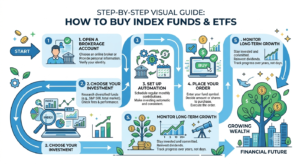
How to Buy Index Funds and ETFs
Regardless of which you choose, the process is straightforward.
Buying Index Funds
- Choose a fund company (Vanguard, Fidelity, Schwab, etc.)
- Open an account (brokerage, IRA, or other)
- Research available index funds
- Check minimum investment requirements
- Set up automatic contributions if possible
- Place your order (executes at end-of-day NAV)
Buying ETFs
- Open a brokerage account
- Fund the account
- Search for the ETF by ticker symbol
- Enter the number of shares or dollar amount
- Place your order (market, limit, or other order type)
- Set up automatic investing if available
Both processes take minutes once your account is funded.
What About Robo-Advisors?
If you want investing to be even more hands-off, a robo-advisor can build and manage a diversified portfolio for you using ETFs or index funds.
Robo-advisors handle asset allocation, automatic rebalancing, dividend reinvestment, and tax-loss harvesting. You simply fund your account and let the platform do the work.
We will cover this topic in depth in our upcoming guide on . If you prefer complete automation and do not want to choose individual funds, robo-advisors are worth considering.
Building a Portfolio With Index Funds or ETFs
Once you have decided on index funds, ETFs, or a combination, how do you actually build a portfolio?
The Simple Three-Fund Portfolio
A classic beginner strategy uses three broad index funds or ETFs:
- U.S. total stock market fund
- International stock market fund
- U.S. bond market fund
You adjust the percentages based on your age, risk tolerance, and timeline.
The Even Simpler One-Fund Portfolio
An all-in-one target-date retirement fund or balanced index fund handles diversification for you. This is the easiest approach for hands-off investors.
The Two-Fund Portfolio
Some investors prefer just two funds:
- Total world stock market fund (U.S. and international combined)
- Total bond market fund
This reduces decision-making while maintaining diversification.
The exact structure matters less than staying diversified, keeping costs low, and remaining consistent.
Tax Considerations for Index Funds and ETFs
Taxes can significantly impact your long-term returns, especially in taxable accounts.
In Tax-Advantaged Accounts
In IRAs, 401(k)s, and other retirement accounts, the tax efficiency difference between index funds and ETFs does not matter. You are not paying taxes on gains annually, so use whichever investment type fits your strategy.
In Taxable Brokerage Accounts
In taxable accounts, ETFs generally have an edge because they distribute fewer capital gains. However, many index funds have also become more tax-efficient over the years.
If you are investing primarily for retirement and using tax-advantaged accounts, this distinction is minor.
Tax-Loss Harvesting
Some robo-advisors and advanced investors use tax-loss harvesting to offset gains with losses. This strategy is easier to implement with ETFs due to their intraday trading flexibility.
https://finance4you.online/cryptocurrency-investing-guide-2026/
Frequently Asked Questions
Are ETFs better than index funds?
Neither is objectively better. ETFs offer more flexibility, lower minimums, and better tax efficiency in taxable accounts. Index funds offer easier automation and simplicity. The right choice depends on your situation, account type, and preferences.
Can you lose money in index funds or ETFs?
Yes, both can lose value when the stock or bond markets decline. They are investments, not guaranteed savings. However, broad market index funds and ETFs have historically recovered and grown over long time periods.
Which has lower fees: index funds or ETFs?
Both can have very low expense ratios. Top index funds and ETFs tracking the same index often have nearly identical fees, such as 0.03% to 0.10% annually. Always compare expense ratios before choosing.
Should I invest in index funds or ETFs in my Roth IRA?
Either can work well in a Roth IRA. Since taxes are not a concern in a Roth IRA, choose based on convenience and automation. If your broker makes automatic investing easier with index funds, use those. If you prefer ETFs for flexibility, use those.
Do ETFs pay dividends like index funds?
Yes, many ETFs distribute dividends and interest to shareholders, just like index mutual funds. You can choose to reinvest those dividends automatically to buy more shares.
Can I hold both index funds and ETFs in the same portfolio?
Absolutely. Many investors use index mutual funds in retirement accounts and ETFs in taxable accounts, or they simply choose whichever option is most convenient for each investment goal.
Conclusion: Both Work—Pick the One That Fits Your Life
The debate between index funds and ETFs often feels more complicated than it actually is. The truth is that both are excellent tools for building long-term wealth through passive investing. They offer broad diversification, low costs, and proven track records.
The differences matter, but they are not deal-breakers. If you are starting with $100, ETFs make it easy to begin immediately. If you value seamless automation, index funds traditionally excel. If you want tax efficiency in a taxable account, ETFs have an edge. If you are investing in a 401(k) or IRA, the choice often comes down to what your plan offers or personal preference.
The most important decision is not index fund versus ETF. The most important decision is to start investing, stay consistent, keep costs low, and remain invested for the long term.
Whether you choose index funds, ETFs, or a combination of both, you will be far ahead of the majority of people who never start at all.
Ready to build your investment portfolio? Start with our beginner-friendly guide on , explore robo-advisors in our upcoming , and make sure your financial foundation is solid by reading and comparing . Use or to make room in your budget for consistent contributions.
The best investment is the one you actually make. Choose index funds or ETFs, set up your account, and start building your future today.
Disclaimer: This article is for informational and educational purposes only and does not constitute financial, investment, tax, or legal advice. Investing involves risk, including possible loss of principal. Index funds and ETFs can lose value. Consider consulting a qualified financial advisor before making investment decisions.