


Introduction
Not long ago, investing was viewed as purely about financial returns. You chose investments based on which companies would make the most money, regardless of what those companies did or how they operated. The idea that your investments could reflect your values or contribute to positive change seemed idealistic at best and financially foolish at worst.
That mindset has fundamentally shifted.
Today, sustainable investing—also called ESG investing, socially responsible investing, or impact investing—has moved from niche to mainstream. Trillions of dollars are now invested in funds that consider environmental, social, and governance factors alongside financial performance. Major investment firms offer ESG portfolios. Retirement plans include sustainable options. Even traditional investors are asking how companies address climate change, labor practices, and corporate ethics.
But with this growth comes confusion. What exactly is sustainable investing? How do ESG funds work? Do they sacrifice returns for values, or can you have both? How do you avoid “greenwashing”—companies falsely claiming sustainability? And most importantly, is sustainable investing right for you?
This guide will answer all these questions. You will learn what ESG investing actually means, how to evaluate sustainable funds, the real performance data, the risks and criticisms, and how to build a portfolio aligned with both your financial goals and your values.
By the end, you will understand whether sustainable investing fits your strategy and how to approach it intelligently. you can also read this https://finance4you.online/side-hustle-ideas-2026/
Let’s start with the fundamentals.
What Is Sustainable Investing?
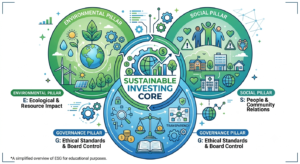
Sustainable investing is an investment approach that considers environmental, social, and governance (ESG) factors alongside traditional financial analysis when selecting investments. Instead of focusing solely on profit potential, sustainable investing evaluates how companies impact the world and how those impacts might affect long-term returns.
The Three Pillars of ESG
Environmental (E):
How does the company impact the natural world? This includes:
- Climate change and carbon emissions
- Energy efficiency and renewable energy use
- Water usage and conservation
- Waste management and pollution
- Biodiversity and ecosystem protection
- Natural resource depletion
Social (S):
How does the company treat people and communities? This covers:
- Labor practices and working conditions
- Employee diversity and inclusion
- Human rights throughout the supply chain
- Community relations and impact
- Product safety and consumer protection
- Data security and privacy
Governance (G):
How is the company managed and led? This examines:
- Board composition and independence
- Executive compensation practices
- Shareholder rights and transparency
- Business ethics and anti-corruption measures
- Political contributions and lobbying
- Tax practices
Companies with strong ESG practices are theoretically better positioned for long-term success because they manage risks better, attract talent, satisfy customers, and adapt to changing regulations.
Different Names, Slightly Different Meanings
You may hear several terms used somewhat interchangeably:
ESG investing: Focuses specifically on environmental, social, and governance criteria
Sustainable investing: Broader term emphasizing long-term sustainability
Socially responsible investing (SRI): Often involves excluding certain industries like tobacco or weapons
Impact investing: Specifically targets measurable positive social or environmental outcomes
Green investing: Focuses primarily on environmental benefits
While nuances exist, all these approaches share a common goal: aligning investments with values beyond pure financial return.
How ESG Investing Works
Sustainable investing uses several strategies to incorporate values into investment decisions.
ESG Integration
ESG integration means systematically including environmental, social, and governance factors in traditional financial analysis. Fund managers assess how ESG issues might affect a company’s financial performance and risk profile.
For example, a company heavily reliant on fossil fuels might face long-term risks from climate regulations, making it potentially less attractive even from a purely financial perspective.
Negative Screening (Exclusion)
This approach excludes certain industries or companies from investment consideration based on values. Common exclusions include:
- Tobacco companies
- Weapons manufacturers
- Fossil fuel producers
- Gambling operations
- Alcohol producers
- Companies with poor labor practices
Negative screening allows investors to avoid profiting from industries they find objectionable.
Positive Screening (Best-in-Class)
Rather than excluding entire industries, positive screening identifies companies with the strongest ESG performance within each sector. A “best-in-class” approach might still invest in oil companies but only choose those leading on environmental practices and renewable energy transition.
Thematic Investing
Thematic ESG funds focus on specific sustainability themes like:
- Renewable energy
- Clean water
- Sustainable agriculture
- Green building
- Gender equality
- Affordable housing
These funds actively seek companies directly addressing particular environmental or social challenges.
Impact Investing
Impact investing targets measurable positive outcomes alongside financial returns. Impact investors want to see documented evidence that their capital creates specific environmental or social benefits, such as reduced carbon emissions or increased access to healthcare.
ESG Funds: Types and Options
If you want to invest sustainably, ESG funds provide convenient diversification. Here are the main types.
ESG Index Funds and ETFs
Just like traditional index funds track broad market indexes, ESG index funds track sustainability-focused indexes. These indexes use ESG criteria to select or weight companies.
Examples include:
- S&P 500 ESG Index funds (companies from the S&P 500 meeting ESG criteria)
- MSCI USA ESG Select Index funds
- Bloomberg SASB US Large Cap ESG Index funds
ESG index funds offer broad diversification, low costs, and passive management while incorporating sustainability screens. This approach often appeals to investors who want ESG exposure without high fees or active management.
For more on how index funds work generally, see our guide on .
Actively Managed ESG Funds
These funds have portfolio managers who actively select companies based on both ESG analysis and financial potential. Active management typically involves higher fees but potentially more sophisticated ESG evaluation.
ESG Bond Funds
Sustainable investing is not limited to stocks. ESG bond funds invest in debt issued by companies or governments with strong sustainability practices or specific environmental projects (like green bonds funding renewable energy).
Target-Date ESG Funds
Some fund companies now offer ESG versions of target-date retirement funds, automatically adjusting allocation as you approach retirement while maintaining ESG criteria throughout.
Do ESG Funds Sacrifice Returns?
The most common question about sustainable investing is: “Am I giving up returns for my values?”
The honest answer: the data is mixed, but increasingly suggests ESG investing can be competitive with traditional investing.
Historical Performance
Multiple academic studies have examined ESG fund performance:
- Some studies show ESG funds perform comparably to traditional funds over long periods
- Others show slight outperformance in certain time frames and market conditions
- A few show underperformance, particularly when ESG screening significantly narrows the investment universe
- ESG funds generally showed resilience during the COVID-19 market crash in 2020
The SEC’s investor guidance notes that there is no guarantee that ESG funds will achieve better returns than other funds, and that ESG fund performance can vary significantly depending on the specific ESG strategies used and the sectors emphasized.
Why ESG Might Not Hurt Returns
Several arguments explain why ESG investing might match or even beat traditional approaches:
Better risk management:
Companies with strong ESG practices may avoid costly lawsuits, regulatory fines, environmental disasters, and reputation damage.
Long-term thinking:
ESG-focused companies often prioritize sustainable business models over short-term profit maximization, potentially creating more durable competitive advantages.
Changing consumer preferences:
As consumers increasingly favor sustainable brands, ESG-conscious companies may capture growing market share.
Regulatory trends:
Governments worldwide are implementing stricter environmental and social regulations. Companies already compliant face fewer adaptation costs.
Talent attraction:
Strong ESG practices help attract and retain top employees who want to work for responsible companies.
The Bottom Line on Performance
While past performance never guarantees future results, evidence suggests ESG investing does not necessarily require sacrificing returns. The key is choosing well-constructed ESG funds with reasonable fees and strong investment processes.
Greenwashing: The Dark Side of ESG
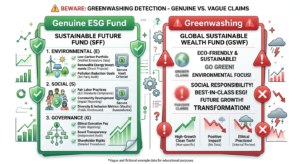
As sustainable investing has grown, so has “greenwashing”—the practice of exaggerating or falsely claiming environmental or social responsibility.
What Is Greenwashing?
Greenwashing occurs when companies or funds market themselves as sustainable without meaningful ESG practices to back it up. This can include:
- Vague sustainability claims without specific metrics
- Cherry-picking a few positive initiatives while ignoring larger problems
- Misleading marketing that overstates environmental benefits
- ESG labels on funds with minimal actual ESG screening
- “Green” products that are only marginally better than alternatives
Why Greenwashing Happens
As investor demand for sustainable products grows, financial firms have strong incentives to offer ESG funds—even if their commitment to sustainability is superficial. Slapping an “ESG” label on a fund can attract assets without requiring fundamental changes to investment approach.
How to Spot Greenwashing
Protect yourself by:
Reading the prospectus:
Understand exactly what ESG criteria the fund uses and how strictly they are applied.
Checking actual holdings:
Look at what companies the fund actually owns. If an “environmental” fund holds major fossil fuel companies, question the commitment.
Reviewing ESG ratings:
Independent organizations like MSCI, Sustainalytics, and Morningstar provide ESG ratings for funds. Compare these ratings to the fund’s marketing claims.
Examining fees:
High fees should come with genuine active ESG research and engagement. Be skeptical of expensive funds with minimal ESG differentiation.
Looking for transparency:
Strong ESG funds clearly disclose their methodology, screening criteria, and how they vote on shareholder resolutions.
The SEC has increased scrutiny of ESG claims and issued guidance requiring funds to accurately describe their ESG strategies in marketing materials.
Criticisms of ESG Investing
Despite its growth, sustainable investing faces legitimate criticisms worth understanding.
Lack of Standardization
No universal definition of ESG exists. Different rating agencies use different criteria and methodologies, sometimes producing contradictory ratings for the same company. A company might score high on one ESG rating system and low on another.
This inconsistency makes it difficult for investors to compare funds and assess actual sustainability impact.
Potential for Lower Diversification
ESG screening excludes certain companies and industries, potentially reducing diversification. A fund excluding all fossil fuel companies, for example, has no exposure to that sector—which could impact performance if that sector performs well.
Subjectivity of Values
What counts as “sustainable” or “socially responsible” varies by individual. Some investors want to exclude fossil fuels entirely; others prefer investing in energy companies transitioning toward renewables. Some avoid all weapons manufacturers; others distinguish between defensive and offensive weapons.
This subjectivity makes creating one-size-fits-all ESG products challenging.
Measurement Challenges
Measuring actual environmental and social impact is difficult. Does buying stock in a green energy company actually help the environment, or are you simply buying shares from another investor? Does screening out certain industries change company behavior, or does it just mean someone else owns those stocks?
These questions remain hotly debated.
Political Controversy
ESG investing has become politicized in some regions. Critics argue it imposes political values on investment decisions or discriminates against certain industries. Some U.S. states have restricted public pension funds from considering ESG factors.
Supporters counter that ESG simply acknowledges material risks and opportunities that affect long-term returns.
How to Start ESG Investing
If sustainable investing aligns with your values and goals, here is how to begin.
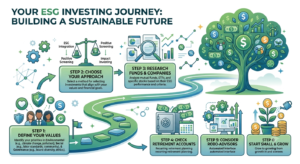
Step 1: Define Your Priorities
Not all ESG is the same. Identify what matters most to you:
- Climate change and environmental protection?
- Social justice and human rights?
- Corporate governance and ethics?
- Specific issues like gender equality, clean water, or renewable energy?
Your priorities will guide which funds you choose.
Step 2: Decide on Your Approach
Choose between:
Broad ESG integration: General ESG funds applying sustainability criteria across all holdings
Thematic focus: Funds targeting specific themes like renewable energy or diversity
Negative screening: Funds excluding specific industries you want to avoid
Impact investing: Funds specifically measuring environmental or social outcomes
Best-in-class: Funds owning the most sustainable companies in each sector
Step 3: Research ESG Funds
Use resources like:
- Morningstar’s ESG fund ratings and analysis
- Fund prospectuses explaining ESG methodologies
- Fund holding disclosures showing what companies they actually own
- Third-party ESG research providers
Compare expense ratios, performance history, ESG criteria rigor, and holdings.
Step 4: Check if Your 401(k) or IRA Offers ESG Options
Many employer retirement plans now include ESG fund choices. Check your plan’s fund menu for options labeled ESG, sustainable, or socially responsible.
If your plan lacks ESG options, you can invest in ESG funds through an IRA. For retirement account basics, review our guide on .
Step 5: Consider Robo-Advisors With ESG Portfolios
Several robo-advisors offer ESG portfolio options:
- Betterment offers socially responsible portfolios
- Wealthfront includes socially responsible investing options
- Ellevest focuses on impact investing
- Other platforms provide ESG-focused automated portfolios
This approach provides professional portfolio construction with ESG integration. For more on automated investing, see our guide on .
Step 6: Start Small and Expand
You do not need to convert your entire portfolio overnight. Consider starting with a portion of your investments in ESG funds while maintaining traditional holdings elsewhere.
Over time, as you learn more about what works for you, you can adjust your allocation.
ESG Investing in Different Account Types
Where you hold your ESG investments matters.
Taxable Brokerage Accounts
ESG funds work like any other investment in taxable accounts. You buy, hold, and potentially sell them, with standard tax treatment on dividends and capital gains.
Some ESG funds may generate slightly higher taxable distributions if active management creates more turnover. Check fund tax efficiency before investing in taxable accounts.
Retirement Accounts (IRAs, 401(k)s)
Many investors hold ESG investments in tax-advantaged retirement accounts. This eliminates concerns about tax efficiency and allows long-term holding aligned with retirement timelines.
Some 401(k) plans now offer ESG fund options. If yours does not, you can request they add sustainable choices.
529 College Savings Plans
Some 529 plans now include ESG fund options, allowing parents to save for education in alignment with their values.
account types https://finance4you.online/money-market-account-vs-savings-account/
The Future of Sustainable Investing
Where is sustainable investing headed?
Growing Mainstream Acceptance
ESG investing continues moving from niche to standard practice. Major investment firms now integrate ESG analysis across most products, not just specialized funds.
Improved Standardization
Regulatory bodies worldwide are working to create clearer ESG disclosure requirements and definitions, which should reduce greenwashing and improve comparability.
Climate Focus
Climate change drives much ESG investment growth. Expect continued focus on carbon emissions, renewable energy transition, and climate risk management.
Technology Integration
Artificial intelligence and big data are improving ESG analysis, allowing more sophisticated evaluation of company practices and real-time monitoring of ESG metrics.
Younger Investor Demand
Millennial and Gen Z investors show particularly strong interest in sustainable investing, suggesting continued growth as these generations accumulate wealth.
Regulatory Evolution
Government policies increasingly incorporate ESG considerations into financial regulation, disclosure requirements, and even investment mandates for public funds.
Balancing Values and Diversification
One practical challenge with ESG investing is maintaining proper diversification while honoring your values.
The Diversification Dilemma
Traditional investment advice emphasizes broad diversification across sectors, geographies, and company sizes. But ESG screening by definition excludes certain investments, reducing diversification.
For example, excluding fossil fuel companies eliminates a significant portion of the energy sector. Avoiding weapons manufacturers removes defense contractors. Each exclusion shrinks your investment universe.
Solutions
Focus on broad ESG funds:
Rather than highly restrictive thematic funds, consider broad ESG funds that screen out the worst performers while maintaining sector diversity.
Combine ESG with traditional:
Hold a core traditional index fund portfolio alongside targeted ESG investments, balancing values with diversification.
Use best-in-class screening:
Instead of excluding entire sectors, choose funds that own the best ESG performers in each sector.
Accept some compromise:
Recognize that perfect alignment of values and optimal diversification may not be possible. Decide which trade-offs you are willing to accept.
The appropriate balance depends on your values, risk tolerance, and financial goals.
Frequently Asked Questions
What is the difference between ESG and SRI investing?
ESG investing integrates environmental, social, and governance factors into investment analysis alongside financial metrics. SRI (socially responsible investing) often emphasizes screening out objectionable industries based on values. ESG tends to be more analytical and performance-focused, while SRI is more values-driven, though the terms overlap significantly.
Do ESG funds cost more than regular funds?
Sometimes. Actively managed ESG funds typically charge higher expense ratios than passive index funds due to additional research and analysis. However, ESG index funds often have expenses comparable to traditional index funds. Compare specific funds rather than assuming all ESG investments are expensive.
Can I invest in ESG funds in my 401(k)?
Many employer retirement plans now offer ESG fund options, though availability varies. Check your plan’s fund menu for options labeled ESG, sustainable, or socially responsible. If your plan lacks these options, you can request they be added or invest in ESG funds through an IRA.
Will ESG investing hurt my returns?
Research suggests ESG funds can perform comparably to traditional funds over the long term, with some studies showing competitive or even superior performance. However, past performance does not guarantee future results, and performance varies widely among individual ESG funds based on their specific strategies.
How do I know if an ESG fund is legitimate or greenwashing?
Read the fund prospectus to understand specific ESG criteria and methodology. Check actual fund holdings to see if they align with stated values. Review third-party ESG ratings from organizations like Morningstar. Look for transparency in how the fund defines and implements sustainability. Beware of vague marketing claims without specific backing.
Can I invest sustainably as a beginner with limited money?
Yes. Many ESG index funds and ETFs have no minimum investment beyond the share price, and some brokerages offer fractional shares allowing you to start with any amount. Several robo-advisors offer ESG portfolios with low or no minimums. If you are just beginning to invest, start with our guide on . also read this https://finance4you.online/cryptocurrency-investing-guide-2026/
Conclusion: Investing With Purpose
Sustainable investing represents a fundamental shift in how many people think about building wealth. No longer must you choose between financial returns and personal values. While challenges remain—including greenwashing, lack of standardization, and ongoing debates about performance—ESG investing has matured into a legitimate mainstream approach.
For investors who care about environmental protection, social justice, corporate ethics, or specific sustainability issues, ESG funds provide a way to align investments with values without necessarily sacrificing financial goals. The key is approaching sustainable investing thoughtfully, researching funds carefully, understanding what ESG criteria actually mean, and maintaining realistic expectations about both impact and returns.
Whether you dedicate your entire portfolio to ESG investments or allocate just a portion, sustainable investing offers a way to build wealth while supporting the kind of world you want to live in.
Ready to build a complete investment strategy? Start with our beginner-friendly guide on , compare traditional and ESG options in , explore automated ESG portfolios through , and ensure your financial foundation is strong with . Use or to make room in your budget for consistent investing aligned with your values.
Invest wisely. Invest responsibly. Build the future you want to see.
Disclaimer: This article is for informational and educational purposes only and does not constitute financial, investment, tax, or legal advice. ESG investing involves risk, including possible loss of principal. ESG fund performance varies, and sustainable investing does not guarantee returns. The mention of specific ESG criteria or themes does not constitute a recommendation. Consider consulting a qualified financial advisor before making investment decisions.