

Introduction
If you’ve ever felt overwhelmed by complicated budgeting spreadsheets or tracking dozens of spending categories, the 50/30/20 budget rule might be exactly what you need.
This simple yet powerful budgeting method breaks your after-tax income into just three easy-to-understand categories: 50% for needs, 30% for wants, and 20% for savings and debt repayment. That’s it. No complex formulas, no dozens of categories to track—just three buckets that make managing your money surprisingly simple.
Popularized by Senator Elizabeth Warren in her book “All Your Worth,” the 50/30/20 rule has become one of the most recommended budgeting strategies for beginners and busy people alike. But is it actually right for your financial situation in 2026?
In this comprehensive guide, I’ll break down exactly how the 50/30/20 rule works, walk you through real-world examples, show you how to calculate your own budget, and honestly discuss whether this method fits your unique circumstances. By the end, you’ll know exactly how to implement it—or whether you should consider an alternative approach.
https://finance4you.online/how-to-create-zero-based-budget-guide/
Let’s get started.
What Is the 50/30/20 Budget Rule?
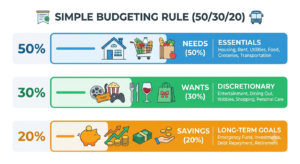
The 50/30/20 budget rule is a straightforward money management strategy that divides your monthly after-tax income into three spending categories:
- 50% for Needs — Essential expenses you can’t avoid
- 30% for Wants — Lifestyle choices and discretionary spending
- 20% for Savings & Debt — Building wealth and paying off debt
The beauty of this rule lies in its simplicity. Instead of tracking every single dollar across dozens of categories (like you would with zero-based budgeting), you only need to ensure your spending stays within these three broad buckets.
This makes the 50/30/20 rule perfect for budgeting beginners, people with straightforward finances, or anyone who wants a low-maintenance approach to managing their money.
The Origin of the 50/30/20 Rule
[H3]
The 50/30/20 rule was introduced by Elizabeth Warren, a Harvard bankruptcy expert (and later U.S. Senator), along with her daughter Amelia Warren Tyagi in their 2005 book “All Your Worth: The Ultimate Lifetime Money Plan.”
Their research on personal finance and bankruptcy revealed that people who maintained this rough balance between needs, wants, and savings tended to have far more financial stability than those who didn’t. The rule was designed to be simple enough that anyone could follow it without an accounting degree.
Breaking Down the Three Categories
Understanding what belongs in each category is crucial for the 50/30/20 rule to work. Let’s examine each bucket in detail.
The 50%: Needs (Essential Expenses)
Needs are expenses you absolutely must pay to live and work. If you stopped paying these, you’d face serious consequences like eviction, loss of transportation, or inability to work.
What counts as a need:
- Rent or mortgage payments
- Utilities (electricity, water, gas, heating)
- Groceries (basic food, not dining out)
- Health insurance and essential healthcare
- Transportation to work (car payment, gas, public transit)
- Minimum debt payments
- Basic phone and internet (required for most jobs today)
- Childcare (if needed for work)
- Insurance premiums (auto, health, renters)
What does NOT count as a need:
- Netflix, Spotify, and streaming services
- Dining out and takeout
- Premium cable packages
- Gym memberships (unless medically necessary)
- Brand-name products when generics work
The key question to ask: “Would there be serious consequences if I didn’t pay this?” If yes, it’s a need. If it’s just something you’d prefer, it’s a want.
The 30%: Wants (Lifestyle Choices)
Wants are the things that make life enjoyable but aren’t strictly necessary for survival. This is often the trickiest category because the line between needs and wants can blur.
What counts as a want:
- Dining out and food delivery
- Streaming services and entertainment
- Hobbies and recreational activities
- Vacations and travel
- Shopping for non-essential clothing
- Gym memberships
- Upgraded phone plans
- The latest gadgets and electronics
- Concert tickets and events
Here’s an important distinction: A basic car to get to work is a need, but upgrading to a luxury vehicle is a want. Basic groceries are a need, but that expensive organic specialty food or dining at restaurants falls into wants.
The 20%: Savings and Debt Repayment
This category is where you build your financial future. It includes both saving money and paying off debt beyond the minimum payments.
What counts in the 20%:
- Emergency fund contributions
- Retirement savings (401k, IRA)
- Investment contributions
- Extra debt payments (beyond minimums)
- Savings for specific goals (home down payment, car)
- College savings funds
Note that minimum debt payments belong in the “needs” category, while any extra payments to accelerate debt payoff count toward your 20%. This distinction matters because minimum payments are mandatory, while extra payments are a choice that builds your financial health.
If you’re focused on building your safety net, our guide on how to build an emergency fund from scratch shows you exactly how to prioritize your 20% savings allocation.
How to Calculate Your 50/30/20 Budget: Step-by-Step
Now let’s put theory into practice. Here’s how to calculate your own 50/30/20 budget in four simple steps.
Step 1: Determine Your After-Tax Monthly Income
The 50/30/20 rule is based on your take-home pay—the money that actually hits your bank account after taxes, Social Security, and other deductions.
If you receive a regular paycheck, look at your net pay (the amount deposited). If you’re self-employed or have irregular income, calculate your average monthly income after setting aside money for taxes.
Important note: If your employer deducts health insurance or retirement contributions before you receive your paycheck, you have two options:
- Use your gross income and account for these deductions in the appropriate categories
- Use your net income and recognize that some savings/needs are already handled
For simplicity, most people use their net take-home pay.
Step 2: Calculate Your Category Amounts
Once you know your monthly after-tax income, the math is simple:
- Needs: Income × 0.50
- Wants: Income × 0.30
- Savings/Debt: Income × 0.20
Step 3: Use This 50/30/20 Budget Calculator Example
Let’s say your monthly take-home pay is $4,000. Here’s how it breaks down:
| Category | Percentage | Amount |
|---|---|---|
| Needs | 50% | $2,000 |
| Wants | 30% | $1,200 |
| Savings/Debt | 20% | $800 |
| Total | 100% | $4,000 |
Now let’s see this in action with realistic expenses:
NEEDS ($2,000):
- Rent: $1,100
- Utilities: $200
- Groceries: $350
- Car payment: $200
- Gas: $100
- Minimum debt payments: $50
WANTS ($1,200):
- Dining out: $300
- Streaming/subscriptions: $50
- Shopping: $250
- Hobbies: $200
- Entertainment: $200
- Gym: $50
- Travel fund: $150
SAVINGS/DEBT ($800):
- Emergency fund: $300
- Retirement (extra): $300
- Extra debt payment: $200
Step 4: Adjust and Track
After setting up your budget, track your spending for a month to see how closely you match the 50/30/20 targets. Don’t panic if you’re off initially—most people are. The goal is to gradually shift your spending to align with these percentages.
To make tracking easier, consider using one of the best budgeting apps that can automatically categorize your spending into needs, wants, and savings.

https://finance4you.online/how-to-track-expenses/
50/30/20 Budget Examples for Different Income Levels
The percentages stay the same, but the actual dollar amounts change based on your income. Here are examples across different income levels.
Example 1: $3,000 Monthly Income
- Needs (50%): $1,500
- Wants (30%): $900
- Savings (20%): $600
Example 2: $5,000 Monthly Income
- Needs (50%): $2,500
- Wants (30%): $1,500
- Savings (20%): $1,000
Example 3: $7,500 Monthly Income
- Needs (50%): $3,750
- Wants (30%): $2,250
- Savings (20%): $1,500
Notice how higher earners have more flexibility. Someone making $7,500 can put $1,500 toward savings each month, potentially reaching major financial goals much faster than someone earning less.
The 50/30/20 Rule for Low Income Earners
Here’s an honest truth: The 50/30/20 rule can be challenging for people with lower incomes or those living in high-cost areas.
In many expensive cities, rent alone can consume 40-50% of take-home pay, making the “50% for needs” target nearly impossible. If this describes your situation, don’t abandon budgeting altogether—instead, adapt the rule to fit your reality.
Modified Ratios for Tight Budgets
If you can’t hit the traditional percentages, try these adjusted versions:
- 60/30/10: More realistic when needs eat up more income
- 70/20/10: For those in high-cost areas or with lower incomes
- 80/10/10: Survival mode—still saving something, even if small
The important principle is that you’re saving something, even if it’s just 5-10% initially. As your income grows or expenses decrease, you can shift closer to the ideal 50/30/20 split.
Strategies to Make 50/30/20 Work on Low Income
If your needs exceed 50%, focus on these approaches:
- Reduce your biggest expense: Housing is usually the largest cost. Consider roommates, a smaller place, or a lower-cost area.
- Increase your income: A side hustle can help you reach the ideal ratios. Check out our list of side hustle ideas that pay $500+ per month.
- Cut wants temporarily: Reduce the 30% wants category to 15-20% until your situation improves.
- Attack high-interest debt: If debt payments are crushing you, learn how to pay off credit card debt fast to free up income.

Pros and Cons of the 50/30/20 Budget Rule
No budgeting method is perfect for everyone. Let’s honestly examine the strengths and weaknesses of this approach.
Advantages of the 50/30/20 Rule
1. Incredibly Simple With just three categories, it’s the easiest budgeting method to understand and maintain. No spreadsheet expertise required.
2. Flexible Within Categories You have freedom to spend your 30% wants however you like. Love dining out? Spend more there and less on shopping. The choice is yours.
3. Built-In Savings By dedicating 20% to savings and debt, you automatically prioritize your financial future—something many budgets overlook.
4. Reduces Decision Fatigue You don’t have to agonize over every purchase. As long as you’re within your category limits, you’re on track.
5. Great for Beginners It’s the perfect entry point for anyone new to budgeting who feels intimidated by more complex systems.
Disadvantages of the 50/30/20 Rule
1. Too Simplistic for Complex Finances If you have irregular income, multiple financial goals, or complicated expenses, the broad categories may not provide enough structure.
2. Difficult in High-Cost Areas As mentioned, hitting 50% for needs is unrealistic in expensive cities where housing costs dominate.
3. May Not Optimize for Aggressive Goals If you want to retire early or pay off debt rapidly, 20% savings might be too low. Many in the FIRE movement save 40-70% of their income.
4. Categorization Can Be Fuzzy Deciding whether something is a need or want isn’t always clear, which can lead to justifying wants as needs.
50/30/20 Rule vs. Other Budgeting Methods
How does the 50/30/20 rule stack up against other popular budgeting strategies? Let’s compare.
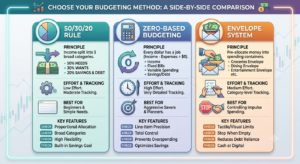
50/30/20 vs. Zero-Based Budgeting
Zero-based budgeting assigns every single dollar a specific job until your income minus expenses equals zero. It’s more detailed and precise but requires more time and effort.
50/30/20 is simpler but less precise. You track three categories instead of dozens.
Verdict: Choose 50/30/20 if you want simplicity; choose zero-based budgeting if you want maximum control and detail. Many people actually combine both—using 50/30/20 as a framework while assigning specific dollar amounts within each category.
50/30/20 vs. Envelope Budgeting
The envelope system involves physically (or digitally) dividing cash into envelopes for different spending categories. It’s excellent for controlling overspending but more hands-on.
50/30/20 is less restrictive and doesn’t require the discipline of cash-only spending.
Verdict: Envelope budgeting works better for chronic overspenders; 50/30/20 suits those who want flexibility.
Tips to Successfully Implement the 50/30/20 Rule
Ready to try the 50/30/20 rule? Here are practical tips to make it stick.
1. Automate Your Savings First
The moment your paycheck arrives, automatically transfer 20% to savings before you can spend it. This “pay yourself first” approach ensures your savings goal is met. Learn more about how to automate your finances to make this effortless.
2. Review Your Needs Honestly
Many people miscategorized wants as needs. Do you really need the premium phone plan, or would a cheaper option work? Regularly audit your “needs” to ensure they’re truly essential.
3. Use Separate Accounts
Consider having separate bank accounts for each category. One for needs (bills), one for wants (spending), and one for savings. This visual separation makes it easier to stay on track.
4. Track for the First Three Months
While 50/30/20 is meant to be low-maintenance, tracking your spending for the first few months helps you understand your patterns and adjust. After that, you can shift to periodic check-ins.
5. Adjust as Life Changes
Got a raise? A new baby? Moved cities? Revisit your budget whenever your circumstances change significantly. The percentages remain constant, but your actual spending needs may shift.
https://finance4you.online/how-to-automate-your-finances/
Frequently Asked Questions About the 50/30/20 Rule
Is the 50/30/20 rule realistic?
For many people with moderate incomes in average-cost areas, yes. However, those in high-cost cities or with lower incomes may need to adjust the ratios. The rule is a guideline, not a rigid law.
Should I use gross or net income for the 50/30/20 rule?
Use your after-tax (net) income—the money that actually lands in your bank account. This gives you a realistic picture of what you have available to allocate.
What if my needs are more than 50%?
This is common, especially with high housing costs. Try adjusted ratios like 60/30/10 or 70/20/10 temporarily. Focus on either reducing your major expenses or increasing your income to eventually reach the ideal split.
Can couples use the 50/30/20 rule?
Absolutely. Combine both incomes and apply the same percentages. Just make sure to communicate about what counts as needs versus wants to avoid conflicts.
Where should my 20% savings go first?
Generally, prioritize in this order: (1) small emergency fund of $1,000, (2) high-interest debt payoff, (3) full emergency fund of 3-6 months expenses, (4) retirement and investments. Our guide on how to save $10,000 in one year provides a detailed savings roadmap.
Is 50/30/20 good for paying off debt?
It’s decent, but if you have significant high-interest debt, you might want to temporarily increase your savings/debt category to 30% or more to eliminate debt faster.
Is the 50/30/20 Budget Rule Right for You?
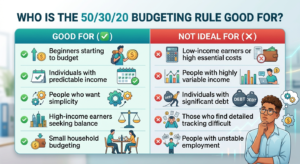
The 50/30/20 rule is an excellent choice if you:
✅ Are new to budgeting and want something simple ✅ Have a stable, predictable income ✅ Prefer flexibility over rigid tracking ✅ Live in an area with reasonable living costs ✅ Want a balanced approach to spending and saving
It might NOT be the best fit if you:
❌ Have very irregular or unpredictable income ❌ Live in an extremely high-cost area ❌ Want to aggressively pursue early retirement ❌ Have complex finances with multiple goals ❌ Struggle with overspending and need strict controls
Remember, the best budget is the one you’ll actually follow. If the 50/30/20 rule feels too loose, try zero-based budgeting for more structure. If it feels too restrictive, you can loosen the categories to fit your lifestyle.
Conclusion: Simple Budgeting for Real Life
The 50/30/20 budget rule proves that managing your money doesn’t have to be complicated. By dividing your income into just three categories—50% needs, 30% wants, and 20% savings—you get a clear, flexible framework that balances enjoying life today with building wealth for tomorrow.
Is it perfect? No budgeting method is. But its simplicity is exactly what makes it so effective for millions of people. You don’t need to track dozens of categories or spend hours managing spreadsheets. You just need to keep your spending within three broad buckets.
Start by calculating your after-tax income, then divide it using the 50/30/20 formula. Track your spending for a few months, adjust as needed, and don’t stress if you’re not perfect right away. The goal is progress, not perfection.
Whether you’re just beginning your financial journey or looking for a simpler system, the 50/30/20 rule offers a proven path toward financial stability and peace of mind.
Ready to take control of your finances? If you want more detailed control, explore our guide on how to create a zero-based budget. To make budgeting easier, check out the best budgeting apps for 2026, or learn how to track your expenses effectively to ensure you stay within your 50/30/20 targets.
Your journey to financial freedom starts with a single budget. Which method will you choose?