
Introduction
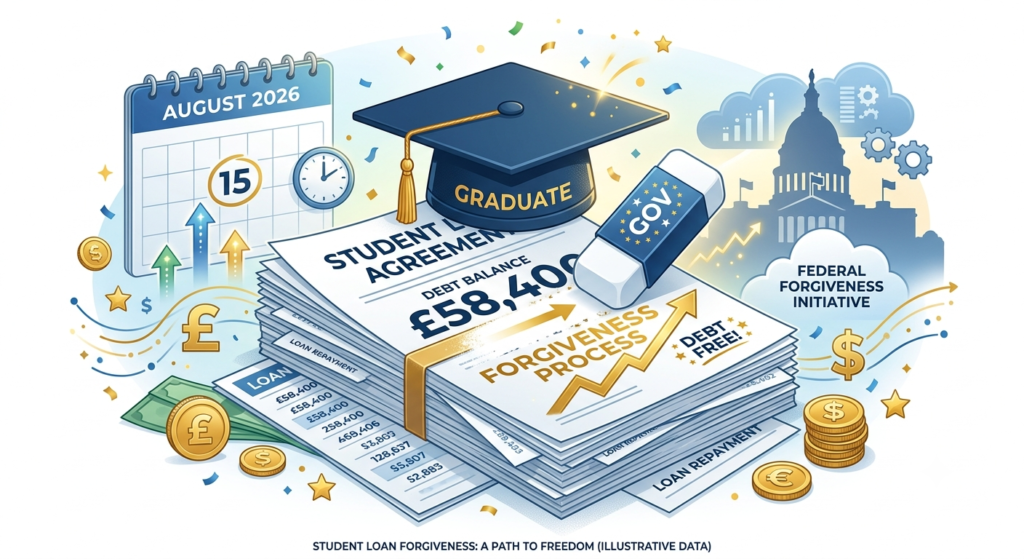
If you’ve been following student loan news over the past few years, you’re probably exhausted. Programs have been announced, challenged in court, struck down, replaced, and renamed—sometimes all within the same year. It’s no wonder millions of borrowers have no idea what they actually qualify for anymore.
Here’s what makes 2026 such a pivotal year: the entire federal repayment system has been restructured. The popular SAVE plan is gone, a brand-new plan called RAP has launched, and major changes to Public Service Loan Forgiveness took effect this summer. Some deadlines have already passed—and others are approaching fast.
But here’s the most important thing you need to know: 6PSLF, IBR forgiveness, borrower defense, disability discharge, teacher loan forgiveness, and closed school discharge are all accepting applications in 2026 — it is not too late. Forgiveness is still very real. You just need to understand the new rules.https://finance4you.online/debt-consolidation-vs-debt-settlement/
In this guide, I’ll walk you through Student Loan forgiveness program still available in 2026, what changed this year, who qualifies, and the exact steps to protect your progress. Let’s cut through the confusion.
First, Let’s Clear Up the Biggest Misconception
Before we cover what’s available, let’s address what’s not—because millions of borrowers are still waiting for something that will never arrive.
The Biden One-Time Forgiveness Is Gone
6 The application most people remember is the one-time debt relief form that briefly opened at StudentAid.gov, where the Biden administration promised to cancel up to $10,000 in federal student debt—up to $20,000 for Pell Grant recipients. Tens of millions of borrowers applied in late 2022. Then the Supreme Court struck the program down in June 2023, before a single loan was discharged under it. 6 A second, narrower attempt—sometimes called “Plan B”—was tied up in court and never took effect. 6 That specific application is closed, and it isn’t coming back. That doesn’t mean there’s nothing left to apply for—it means you’re applying for the wrong thing.
So what does still work? Let’s go program by program.
Public Service Loan Forgiveness (PSLF): Still the Gold Standard
PSLF remains the most powerful forgiveness program in existence—and despite the headlines, it’s still running.
How PSLF Works
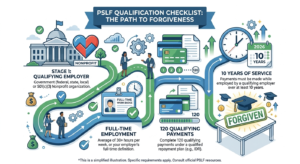
1 The Public Service Loan Forgiveness (PSLF) program was established in 2007 to help borrowers pay off their student loan debt easier and faster. Under the federal program, eligible borrowers can have their loans discharged after 10 years if they meet eligibility requirements. Specifically, 14 the program forgives the remaining balance on your Direct Loans after you make 120 payments in a qualifying repayment plan while working at least 30 hours per week for the government or most types of nonprofits.
Who Qualifies for PSLF in 2026
2 Employment remains the cornerstone of PSLF eligibility. Generally, borrowers must work full-time for a qualifying employer, including federal, state, local or tribal government agencies, plus most 501(c)(3) nonprofits. 4 Healthcare workers, teachers, military personnel, first responders and many nonprofit employees may all qualify.
Not sure about your employer? 2Borrowers can use the Department of Education’s PSLF Help Tool to verify whether their employer qualifies before counting on future payments toward forgiveness.
Is PSLF Safe From Elimination?
This is the question on everyone’s mind, and the answer is reassuring: 12PSLF is a statutory program—Section 455(m) of the Higher Education Act—and only Congress can eliminate it. No executive order, no rulemaking, and no agency reorganization can end the program on its own. Existing payment counts and completed forgiveness discharges are protected.
What Changed With PSLF in 2026
There was significant drama around employer eligibility this year. 9At the end of October, the Department of Education finalized its rule to narrow eligibility for PSLF in response to a March executive order directing the education secretary to redefine what “public service” means. However, in a major development, 12a Department of Education final rule on which employers qualify was vacated in court on June 30, 2026—the day before its effective date; the Repayment Assistance Plan (RAP) launched July 1 under the One Big Beautiful Bill Act; and a March 2026 revision changed the PSLF buyback formula.
The bottom line: 2PSLF remains available right now, but understanding whether you’re eligible requires more than simply knowing where you work.
Which Repayment Plans Count Toward PSLF Now
This is where 2026’s changes matter most. Your employer can qualify and your loans can qualify—but if you’re on the wrong repayment plan, your payments don’t count. Here’s the current lineup:
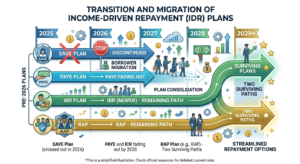
10 What changed on July 1, 2026 is the plan lineup: the 10-year Standard Repayment Plan qualifies (the legacy fixed 10-year plan for borrowers whose loans predate July 1, 2026). Income-Based Repayment (IBR) qualifies—both the original version and the 2014 version. The Repayment Assistance Plan (RAP) qualifies—the new income-driven plan that launched July 1, 2026. Pay As You Earn (PAYE) qualifies only through June 30, 2028. Income-Contingent Repayment (ICR) qualifies only through June 30, 2028. The Graduated Repayment Plan doesn’t qualify. The Extended Repayment Plan doesn’t qualify—neither the fixed nor the graduated version. The Tiered Standard Plan doesn’t qualify—every tier, including the 10-year tier. SAVE: shut down.
One crucial note for former SAVE borrowers: 10payments you made under it still count; months in its forbearance don’t.
The End of SAVE and the Rise of RAP
The single biggest story of 2026 is the death of one plan and the birth of another.
SAVE Is Officially Over
7 After a few contentious years of paused payments and a legal battle that made it all the way to the U.S. Supreme Court, the Biden-era Saving on a Valuable Education (SAVE) plan is officially ending. If you’re one of the more than 7 million borrowers still enrolled in SAVE—the most flexible and generous income-driven repayment plan—you may have already gotten a notice from the U.S. Department of Education warning you that you’ll have to switch plans soon.
If that’s you, act quickly: 13you have a 90-day window starting July 1, 2026, to select a new plan. IBR and RAP are the primary choices. IBR offers $0 payments when your income is low enough and caps payments when your income is high. And don’t drag your feet—11loans parked in SAVE administrative forbearance don’t earn qualifying payment credit while they sit there. Moving to an active plan—IBR now, or RAP as of July 1, 2026—restores active repayment and forgiveness credit.https://finance4you.online/how-to-pay-off-credit-card-debt-fast/
Meet RAP: The New Income-Driven Plan
3 The Repayment Assistance Plan (RAP) offers an income-driven approach, setting your payments at 1% to 10% of your adjusted gross income (or a flat $10 per month if your income is less than $10,000 per year). It can end in forgiveness if you’re still carrying a balance after 30 years of repayment.
Importantly for public servants: 11Public Service Loan Forgiveness is not affected by this. PSLF credit counts on any qualifying income-driven plan, and RAP qualifies. Moving to RAP does not put a PSLF track at risk—the payments still count toward your 120.
What New Borrowers Face
If you’re taking out loans now, your menu is much shorter. 3Starting on July 1, 2026, the federal student loan system will have a much narrower set of repayment options for new loans. If you borrow after that date, you’ll have two repayment plans to choose from: a Standard Repayment Plan featuring fixed monthly payments spanning 10 to 25 years depending on your loan amount, and RAP. In fact, 3for loans disbursed after July 1, 2026, the new RAP option will be the only income-driven repayment plan.
Income-Driven Repayment (IDR) Forgiveness: The Long Game
Even if you don’t work in public service, you can still earn forgiveness through income-driven repayment—it just takes longer.
How IDR Forgiveness Works
4 Borrowers enrolled in qualifying income-driven repayment (IDR) plans may become eligible for forgiveness after making the required number of qualifying payments. Depending on the plan and when the loans were borrowed, forgiveness generally occurs after 20 or 25 years of repayment for existing IDR plans.
Here are the current forgiveness timelines: 13IBR forgives after 20 years (New IBR) or 25 years (Old IBR). PAYE forgives after 20 years. ICR forgives after 25 years. RAP forgives after 30 years.
The Future of IDR Plans
The landscape is consolidating: 11IBR stays open indefinitely for borrowers with loans disbursed before July 1, 2026. After July 1, 2028—when PAYE and ICR close—IBR and RAP will be the only two income-driven repayment plans left.
Also good news for enrollment access: 13the OBBBA removed the partial financial hardship requirement for IBR, which was the only income-based barrier to IDR enrollment. RAP has no income restriction.
Don’t Forget Annual Recertification
One housekeeping item that trips up thousands of borrowers: 13you must recertify your income and family size every year. If you miss the recertification deadline, your payment reverts to the amount due under the Standard Repayment Plan, and on legacy plans, any outstanding interest capitalizes. Set a calendar reminder—or better yet, build it into your system using our guide on how to automate your finances.
⚠️ The New Tax Trap: Forgiveness May Now Be Taxable
This is arguably the most under-reported change of 2026, and it could cost you thousands.
13 Non-PSLF IDR forgiveness is taxable income under current law. The American Rescue Plan Act exemption that made forgiven student loan balances tax-free expired on December 31, 2025. If your loans are forgiven through IDR after 2025, the forgiven amount is added to your taxable income for that year.
The critical exception: 3you don’t have to pay federal taxes on loan cancellation from Public Service Loan Forgiveness. 12Most income-driven repayment forgiveness became taxable again at the federal level on January 1, 2026—but PSLF was not affected.
What this means for you: If you’re approaching IDR forgiveness, start planning for a potential tax bill now. Building a dedicated savings buffer is essential—our guide on how to build an emergency fund from scratch can help you prepare.
Other Forgiveness and Discharge Programs Still Open in 2026
Beyond the big two (PSLF and IDR), several targeted programs remain fully operational.
Teacher Loan Forgiveness
This long-standing program offers up to $17,500 in forgiveness for eligible teachers who work five consecutive years in low-income schools. It’s separate from PSLF—and in some cases, PSLF may actually be more valuable for teachers, so compare both paths before committing.
Borrower Defense to Repayment
If your school misled you or violated the law, you may qualify to have your loans discharged through borrower defense—a program that remains open for applications.
Total and Permanent Disability Discharge
Borrowers with a total and permanent disability can apply to have their federal loans discharged entirely.
Closed School Discharge
If your school closed while you were enrolled or shortly after you withdrew, you may qualify for a full discharge of the loans you took out to attend.
And remember this golden rule: 6your loans, repayment plan, and payment count are all visible at StudentAid.gov, where every federal forgiveness and discharge application is free. Never pay a company for something the government provides for free.
Special Situations: Parent PLUS, FFEL, and Consolidation Traps
Some borrowers need to navigate extra rules—and in 2026, a few wrong moves can permanently close doors.
Parent PLUS Borrowers Face Critical Deadlines
Big change: 3parent loans will no longer qualify for Public Service Loan Forgiveness under the new framework. For existing Parent PLUS borrowers who want to preserve options, one state guide lays out the required steps: 14if you have Parent PLUS Loans that you have not previously consolidated into a Direct Consolidation Loan, and you want to preserve your ability to pay in an income-driven plan: (1) certify your employment now if you are pursuing PSLF, (2) apply to consolidate your Parent PLUS Loans by April 1, 2026, (3) do not take out any federal student loans on or after July 1, 2026, (4) enroll in the Income-Contingent Repayment (ICR) plan and make at least one ICR payment before July 1, 2028, and (5) switch to the Income-Based Repayment (IBR) plan before July 1, 2028.
If you missed the April 2026 consolidation window, contact your servicer immediately to understand your remaining options.
FFEL and Perkins Loan Holders
6 If you have FFEL or Perkins Loans, you may need to consolidate into a Direct Consolidation Loan before you qualify for PSLF. But be careful—the math changed this year: 6 a new consolidation can no longer be repaid under IBR, PAYE, or ICR, so consolidating today puts you on the Repayment Assistance Plan’s 30-year clock instead of IBR’s. Weigh this trade-off carefully before consolidating.
A Warning for IBR Borrowers Pursuing PSLF
10 Taking out any new Direct Loan on or after July 1, 2026 generally ends IBR access for your entire loan portfolio—all your Direct Loans would move to the new plans, with RAP as the income-driven option that keeps your PSLF clock running. If you’re mid-PSLF on IBR, think twice before borrowing again.
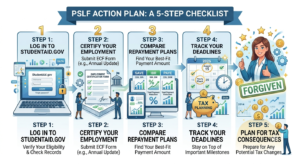
Your 2026 Action Plan: 5 Steps to Protect Your Forgiveness
Feeling overwhelmed? Here’s your simple checklist.
Step 1: Log In and Verify Everything
5 Know your repayment plan. Log in to studentaid.gov and confirm which repayment plan you’re on. Check your loan types, payment counts, and servicer information while you’re there.
Step 2: Certify Your Employment (PSLF Borrowers)
Submit an Employment Certification Form now and every year going forward. 1An employer is eligible for PSLF when Employment Certification Forms (ECFs) are submitted and verified. This locks in your progress and catches problems early.
Step 3: Pick Your Plan Deliberately
3 It’s worth choosing a plan yourself; letting your servicer pick one for you may not be cost-effective or align with your financial goals. Compare IBR vs. RAP based on your income, loan age, and forgiveness timeline.
Step 4: Write Down Your Deadlines
3 There are a lot of dates to keep track of, so write down any deadlines that may apply to your loans. The 90-day SAVE transition window, annual recertification, and the 2028 PAYE/ICR sunset all matter.
Step 5: Plan for Taxes and Build Your Budget
3 If you’ll be receiving loan discharge from an income-driven plan in 2026 or after, prepare yourself for a potential tax bill on the amount. A strong monthly budget makes room for both loan payments and tax savings—start with our [50/30/20 budget rule guide](#) or go detailed with [zero-based budgeting](#).
https://finance4you.online/how-to-improve-credit-score/
Frequently Asked Questions
Is student loan forgiveness still available in 2026?
Yes, absolutely. 6Forgiveness is still available in 2026—the right path depends on your loan type, your repayment history, and where you work. PSLF, IDR forgiveness, teacher loan forgiveness, borrower defense, disability discharge, and closed school discharge all remain open.
Did PSLF requirements change in 2026?
10 The PSLF program requirements haven’t changed—you still need 120 qualifying payments while working full-time for a qualifying employer. What changed is the repayment plan lineup and a contested employer-eligibility rule that 12 was vacated in court on June 30, 2026—the day before its effective date.
What happened to the SAVE plan?
11 SAVE has ended. Former SAVE borrowers have 13 a 90-day window starting July 1, 2026, to select a new plan, with IBR and RAP as the primary choices.
How long until my loans are forgiven on an income-driven plan?
It depends on your plan: 13IBR forgives after 20 years (New IBR) or 25 years (Old IBR), PAYE forgives after 20 years, ICR forgives after 25 years, and RAP forgives after 30 years. 13PSLF is available on all IDR plans after 120 qualifying payments while employed full-time by a qualifying public service employer.
Will I owe taxes on forgiven student loans?
For PSLF, no—it remains federally tax-free. For IDR forgiveness, likely yes: 13the exemption that made forgiven balances tax-free expired on December 31, 2025. If your loans are forgiven through IDR after 2025, the forgiven amount is added to your taxable income for that year.
Should I refinance my federal loans instead?
Be extremely cautious. Refinancing federal loans with a private lender permanently forfeits access to forgiveness programs, income-driven plans, and federal protections. It generally only makes sense if you have high income, excellent credit, and zero interest in forgiveness. If you’re weighing borrowing options broadly, see our guide on how to get the best personal loan rates—and note that a strong credit score matters either way, so check out how to improve your credit score in 90 days.
Conclusion: Forgiveness Is Alive—But It Rewards the Informed
The student loan world of 2026 is undeniably more complicated than it was a few years ago. SAVE is gone, RAP is here, PAYE and ICR are on a countdown to 2028, and IDR forgiveness now comes with a potential tax bill. It’s a lot to absorb.
But step back and the core truth remains: forgiveness programs are alive and processing applications. Public servants can still erase their balances tax-free after ten years. Every borrower on an income-driven plan is still on a path to eventual forgiveness. Teachers, disabled borrowers, and defrauded students still have dedicated programs.
The difference between borrowers who get forgiveness and those who don’t usually isn’t eligibility—it’s information and action. Log into StudentAid.gov today, confirm your plan, certify your employment if you’re pursuing PSLF, and mark your deadlines. Thirty minutes of effort now can protect years of progress.
Want to strengthen your whole financial picture while you work toward forgiveness? Free up extra money with our guide on how to pay off credit card debt fast, keep every payment on time by learning how to automate your finances, and if you’re juggling multiple debts, compare your options in debt consolidation vs debt settlement. Your debt-free future is still on the table—claim it.
Disclaimer: This article is for informational purposes only and does not constitute financial, legal, or tax advice. Student loan rules change frequently and legal challenges are ongoing. Always verify current program details at StudentAid.gov and consider consulting a student loan counselor or attorney for your specific situation.