


Introduction
Imagine waking up on the first of the month knowing that your bills are paid, your savings account just grew, your investments received their contribution, and your debt balance shrank—all without you lifting a finger. This isn’t a fantasy for the wealthy or financially obsessed. It’s the reality of automated finances, and anyone can set it up.
Here’s a hard truth about money management: willpower fails. You might have every intention of saving money each month, but when payday arrives, that money somehow gets spent before it ever reaches your savings account. Life happens. You forget. Temptation wins. This is exactly why manual money management so often falls short.
Automation solves this problem by removing you from the equation. When your finances run on autopilot, good financial decisions happen automatically, whether you feel motivated or not. You save without thinking about it, pay bills without late fees, and invest consistently without the emotional rollercoaster.https://finance4you.online/how-to-create-zero-based-budget-guide/
In this guide, I’ll show you exactly how to automate your finances step by step, along with seven powerful tools that make it effortless. By the end, you’ll have a complete “set it and forget it” system that builds wealth in the background while you focus on living your life. Let’s get started.
Why Automating Your Finances Is a Game-Changer
Before we dive into the how-to, let’s explore why automation is one of the smartest financial moves you can make. Understanding these benefits will motivate you to set up your own system.
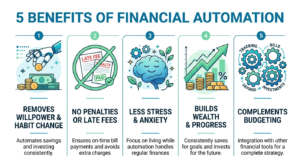
It Removes Willpower From the Equation
The single biggest advantage of automation is that it makes good financial habits effortless. Instead of relying on discipline and memory every single month, you set up your system once and let it run. Your savings happen whether you’re motivated or not, whether you remember or not.
This “pay yourself first” approach ensures that saving and investing happen before you have a chance to spend the money. It’s a proven strategy used by successful savers everywhere.
It Eliminates Late Fees and Penalties
Missing a bill payment isn’t just stressful—it’s expensive. Late fees, penalty interest rates, and dinged credit scores can cost you hundreds of dollars a year. When your bills pay themselves automatically, you never miss a due date again.
It Reduces Financial Stress and Mental Load
Managing money manually requires constant attention. You have to remember due dates, transfer money between accounts, and make dozens of small financial decisions every month. Automation offloads all of this mental burden, freeing up your energy for more important things.
It Builds Wealth Consistently Over Time
Consistency is the secret to building wealth, and nothing is more consistent than automation. By automatically investing the same amount every month regardless of market conditions, you benefit from dollar-cost averaging and steady, long-term growth.
It Complements Any Budgeting System
Automation works hand in hand with whatever budgeting method you use. Whether you follow a zero-based budget or the simpler 50/30/20 rule, automating your allocations ensures your budget actually happens instead of just existing on paper.
The 5 Pillars of Financial Automation
Before choosing tools, it helps to understand what parts of your financial life you can actually automate. Think of these as the five pillars of a fully automated money system.
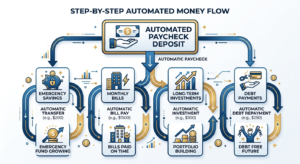
Pillar 1: Automatic Income Deposits
Everything starts with your paycheck. If your employer offers direct deposit, this is your foundation. Your income lands in your account automatically, ready to be distributed to its various jobs. If you can split your direct deposit across multiple accounts, even better—you can send money straight to savings before it ever hits your checking account.
Pillar 2: Automatic Bill Payments
Your recurring bills—rent or mortgage, utilities, insurance, phone, internet, and loan payments—can all be set to pay automatically. This ensures you never miss a due date and never pay a late fee again.
Pillar 3: Automatic Savings Transfers
This is where wealth-building begins. By automatically transferring money to your savings the moment you get paid, you prioritize your future self. Whether it’s building an emergency fund or saving for a specific goal, automation makes it happen consistently.
Pillar 4: Automatic Investments
Investing consistently is one of the most powerful ways to build long-term wealth. By automating contributions to your retirement accounts and investment portfolios, you invest steadily over time without trying to time the market.
Pillar 5: Automatic Debt Payments
Setting up automatic payments toward your debts—both minimums and extra payments—ensures steady progress toward becoming debt-free. Many lenders even offer a small interest rate discount for enrolling in autopay.
How to Automate Your Finances: Step-by-Step
Now let’s put it all together. Follow these steps to build your complete automated money system from scratch.
Step 1: Map Out Your Money Flow
Before automating anything, understand where your money currently goes. List your income, then all your expenses, savings goals, and debt payments. If you haven’t tracked your spending yet, our guide on how to track your expenses effectively will help you get a clear picture.
This map becomes the blueprint for your automation. You need to know exactly what needs to be paid, saved, and invested before you can put it on autopilot.
Step 2: Set Up Direct Deposit
Contact your employer’s HR or payroll department to set up direct deposit if you haven’t already. If your employer allows it, split your deposit so a portion goes directly into savings and the rest into checking. This is the simplest form of “paying yourself first.”
Step 3: Automate Your Savings First
Immediately after your paycheck arrives, schedule automatic transfers to your savings accounts. The key is timing these transfers for the day after payday, so the money moves to savings before you have a chance to spend it.
Start with whatever amount you can manage—even $50 per paycheck adds up over time. As you get comfortable, gradually increase the amount.
Step 4: Set Up Automatic Bill Payments
Go through each of your recurring bills and enroll in autopay. You have two options: pay directly through each biller’s website, or use your bank’s bill pay feature to manage everything in one place. For fixed bills like rent or loan payments, full autopay works perfectly. For variable bills like utilities, you may want to set up alerts so you can review the amount before it’s paid.
Step 5: Automate Your Investments
Set up automatic contributions to your retirement accounts and investment portfolios. If you have a 401(k) through work, contributions are typically deducted automatically from your paycheck—make sure you’re contributing at least enough to get any employer match. For other investments, schedule recurring automatic transfers to your brokerage or robo-advisor account.
Step 6: Automate Debt Payments
Enroll in autopay for all your debts to ensure you never miss a payment. Set up at least the minimum payment automatically, and if your budget allows, automate an extra payment toward your highest-priority debt to accelerate your payoff.
Step 7: Review and Adjust Regularly
Automation isn’t “set it and forget it forever.” Schedule a monthly check-in to review your accounts, confirm everything is working correctly, and make adjustments as your income or expenses change. This quick review ensures your system stays aligned with your goals.
7 Powerful Tools to Automate Your Finances
Now that you understand the strategy, let’s look at the specific tools that make automation effortless. Here are seven categories of tools that handle the heavy lifting for you.
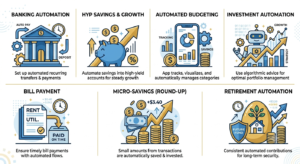
1. Your Bank’s Built-In Automation Features
Don’t overlook the most accessible tool of all—your own bank. Most banks offer free built-in automation features, including recurring transfers, automatic bill pay, and account alerts. You can schedule transfers between accounts, set up bill payments, and receive notifications about your balance and transactions.
Best for: Anyone starting out. These features are free, secure, and already at your fingertips. Start here before adding other tools.
2. High-Yield Savings Accounts
A high-yield savings account is the perfect home for your automated savings. These accounts earn significantly more interest than traditional savings accounts, so your money grows faster while it sits. Set up automatic transfers into one of these accounts, and your emergency fund or savings goals will build themselves.
Best for: Growing your emergency fund and short-term savings goals on autopilot.
3. Budgeting Apps With Automation
Modern budgeting apps do far more than just track spending—many can automate parts of your financial life. They can automatically categorize transactions, send bill reminders, detect subscriptions, and even move money into savings based on your spending patterns. For a complete comparison of the top options, check out our detailed guide on the best budgeting apps for 2026.
Best for: People who want automated tracking alongside their automated money flows.
4. Robo-Advisors for Investing
Robo-advisors are among the best tools for automated investing. These platforms automatically invest your money into diversified portfolios based on your goals and risk tolerance. You set up recurring contributions, and the robo-advisor handles everything else—investing, rebalancing, and optimizing your portfolio automatically.
Best for: Hands-off investors who want professional-level portfolio management without the effort or high fees.
5. Automatic Bill Pay Services
Beyond your bank’s bill pay, dedicated services and apps can help you manage and automate all your bills in one place. Some even analyze your bills, remind you of upcoming charges, and help you cancel unwanted subscriptions—plugging those silent money leaks that drain your budget.
Best for: People juggling many bills and subscriptions who want everything managed automatically.
6. Round-Up Savings Apps
Round-up apps make saving completely painless. Every time you make a purchase, the app rounds up to the nearest dollar and automatically invests or saves the spare change. These small amounts add up surprisingly fast, letting you save money you’ll never even miss.
Best for: Beginners and anyone who struggles to save, since it requires zero effort and no noticeable impact on your budget.
7. Employer-Sponsored Retirement Plans
If your employer offers a 401(k) or similar plan, this is one of the most powerful automation tools available. Contributions are automatically deducted from your paycheck before you ever see the money, and many employers match a portion of your contributions—essentially free money. Set your contribution percentage once, and your retirement savings grow automatically with every paycheck.
Best for: Long-term retirement savings, especially when your employer offers matching contributions.
https://finance4you.online/50-30-20-budget-rule-explained/
Common Automation Mistakes to Avoid
Automation is powerful, but it’s not foolproof. Here are the most common mistakes people make—and how to avoid them.
Mistake 1: Setting It and Completely Forgetting It
While automation reduces the work, it doesn’t eliminate the need for oversight. Automated systems can fail—a card expires, a transfer bounces, or a bill amount changes unexpectedly. Always schedule a monthly review to make sure everything is running smoothly.
Mistake 2: Overdrawing Your Account
If you automate too many transfers and payments without maintaining an adequate buffer, you risk overdrawing your checking account. This can trigger overdraft fees and bounced payments. Keep a cushion in your checking account to absorb timing differences between deposits and withdrawals.
Mistake 3: Automating Before You Have a Budget
Automation amplifies whatever system you have—so if your finances are chaotic, automating that chaos won’t help. First, understand your income and expenses and set up a budget. If you’re new to budgeting, start with the beginner-friendly 50/30/20 rule before automating your money flows.
Mistake 4: Ignoring Variable Bills
Automatically paying variable bills like utilities without reviewing them can lead to surprises. A billing error or an unusually high charge could be paid automatically before you notice. Set up alerts for variable bills so you can review the amount before payment.
Mistake 5: Forgetting to Increase Your Contributions
Many people set up automatic savings and investments and never revisit the amounts. As your income grows, your automated contributions should grow too. Periodically increase your savings and investment amounts to accelerate your progress.
How to Build Your Automated System Around Your Goals
The most effective automated finance systems are built around specific goals. Here’s how to align your automation with what matters most to you.
If Your Goal Is Building an Emergency Fund
Prioritize automatic transfers to a high-yield savings account. Set up a recurring transfer for the day after each payday, and treat it as a non-negotiable expense. To learn exactly how much to save and how to get started, read our guide on how to build an emergency fund from scratch.
If Your Goal Is Paying Off Debt
Automate at least the minimum payments on all debts to protect your credit, then automate an extra payment toward your highest-priority debt. This steady, automatic progress helps you become debt-free faster without relying on willpower.
If Your Goal Is Building Long-Term Wealth
Focus your automation on investments. Max out any employer 401(k) match first, then automate contributions to additional retirement or investment accounts. Consistent, automatic investing over decades is one of the surest paths to building real wealth.
If Your Goal Is Simply Reducing Stress
Automate everything you possibly can—bills, savings, and investments. The less you have to think about money day-to-day, the more mental peace you’ll enjoy. A fully automated system lets you focus on living your life instead of managing spreadsheets.
Frequently Asked Questions About Automating Your Finances
Is it safe to automate my finances?
Yes, automating your finances is generally very safe when you use reputable banks and established financial institutions. These use bank-level encryption and security measures to protect your money and data. The main risk isn’t security—it’s overdrawing your account, which you can prevent by keeping a buffer and reviewing your accounts monthly.
How much should I automate to savings each month?
Start with whatever you can comfortably afford, even if it’s just $25 to $50 per paycheck. A common goal is to automate 20% of your income toward savings and investments, following the 50/30/20 budget rule. The key is to start small if needed and gradually increase the amount as your budget allows.
Should I automate all my bills?
For fixed bills like rent, loan payments, and insurance, full automation works perfectly. For variable bills like utilities or credit cards, consider setting up automation with alerts so you can review the amount before it’s paid. This gives you the benefits of automation while catching any billing errors or unexpected charges.
What if I don’t have enough money to automate savings?
If money is tight, start by tracking your expenses to find room in your budget. Even automating a small amount, like $10 per paycheck, builds the habit and adds up over time. Round-up savings apps are also perfect for this situation, since they save spare change automatically without any noticeable impact on your budget.
How often should I review my automated finances?
A monthly review is ideal. Spend 15 to 30 minutes confirming that all your automated transfers and payments went through correctly, checking your account balances, and making any needed adjustments. This quick check-in ensures your system stays on track and catches any issues early.
Can automation help me if I’m bad with money?
Absolutely—in fact, automation is especially helpful for people who struggle with money management. By removing the need for discipline and memory, automation ensures good financial habits happen regardless of your willpower. It’s one of the most effective tools for anyone who has trouble saving or consistently paying bills on time.
https://finance4you.online/best-budgeting-apps/
Conclusion: Put Your Money on Autopilot Today
Automating your finances is like hiring a tireless personal assistant who never forgets a bill, never skips a savings deposit, and never lets emotions interfere with your investing. Once you set up your system, your money works for you in the background—building wealth, avoiding fees, and reducing stress—all without requiring constant attention or superhuman discipline.
The beauty of automation is that it turns your good intentions into guaranteed actions. You no longer have to rely on remembering to save or finding the willpower to invest. Instead, your best financial decisions happen automatically, month after month, quietly compounding into real wealth over time.
Don’t feel like you have to automate everything at once. Start with one pillar—perhaps automatic savings transfers or bill payments—and build from there. Each piece you automate removes another decision from your plate and another opportunity for human error. Before long, you’ll have a complete system running smoothly on autopilot.
Ready to take control by giving up control? Start by understanding your money with our guide on how to track your expenses effectively, then build a solid budget using the 50/30/20 rule or the detailed zero-based budgeting method. To find the perfect app for your automated system, explore the best budgeting apps for 2026.
Your future self—the one with a fully-funded emergency fund, growing investments, and zero late fees—is counting on the system you set up today. Why not start automating right now?