
Introduction
Imagine this: your car breaks down on the way to work. The repair bill is $800. Do you have the cash to pay it without panic? Or would you be reaching for a credit card, taking out a payday loan, or desperately scrambling to figure out where the money will come from?
If you’re in the second category, you’re not alone—and you’re not failing. Studies consistently show that nearly 40% of Americans can’t cover a $400 emergency expense from savings. That single statistic reveals why so many people feel trapped in a cycle of debt and stress, even when they’re working hard and trying to do everything right.
Here’s the truth that changes everything: an emergency fund is the single most important piece of your financial foundation. It’s more important than investing, more urgent than paying off low-interest debt, and more powerful than any budgeting trick. Without emergency savings, every unexpected expense becomes a crisis. With it, those same surprises become minor inconveniences.
In this comprehensive guide, I’ll show you exactly how to build an emergency fund from absolute zero, even if money is tight right now. You’ll learn how much you actually need, where to keep it, and the fastest proven strategies to reach your goal—whether that’s $500, $1,000, or a full six months of expenses. By the end, you’ll have a clear roadmap to financial security.
Let’s get started.
What Is an Emergency Fund (And Why You Need One)
Before we talk about building one, let’s be crystal clear about what an emergency fund actually is and what it does for you.
The Definition
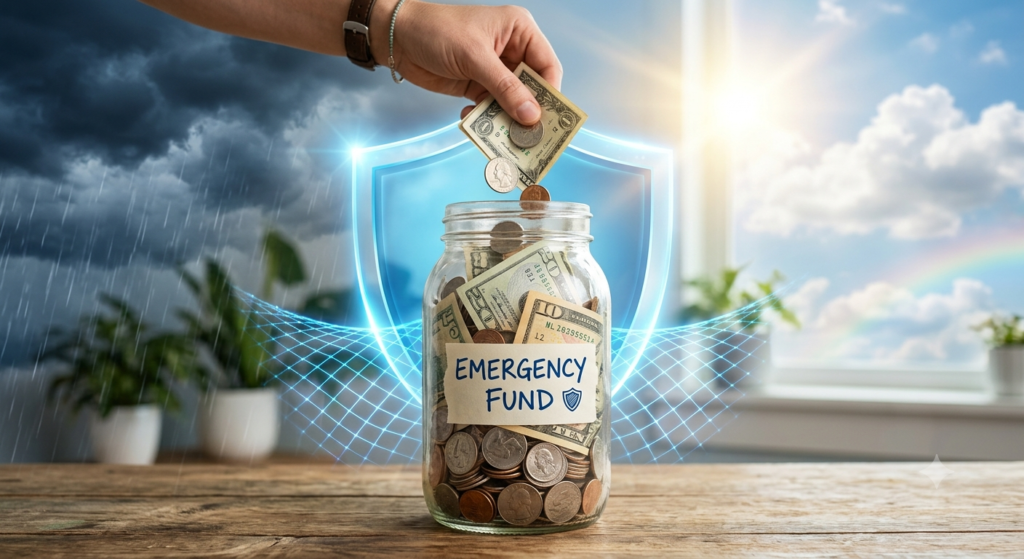
An emergency fund is money set aside specifically for unexpected expenses or financial emergencies. It sits in a separate, easily accessible account that you don’t touch unless you face a genuine emergency—job loss, medical bills, urgent home or car repairs, or other unforeseen costs.
Why It’s Non-Negotiable
Think of your emergency fund as financial insurance you pay to yourself. Just like you wouldn’t drive without car insurance or live without health insurance, you shouldn’t navigate life without this financial safety net.
Without emergency savings, you’re one flat tire, one broken appliance, or one unexpected medical bill away from going into debt. Every surprise expense has to be charged to a credit card or borrowed somehow, which starts the debt cycle that’s so hard to escape. Our guide on how to pay off credit card debt fast is full of stories from people who got into debt precisely because they lacked emergency savings when life threw them a curveball.
With an emergency fund, you handle these situations with cash. The stress evaporates. You fix the problem, move on with your life, and your financial plan stays intact.
The Peace of Mind Factor
Beyond the practical protection, there’s something less tangible but equally valuable: peace of mind. Knowing you have money set aside to handle whatever comes creates a profound sense of security. You sleep better. You worry less. You make clearer decisions because you’re not operating from a place of constant financial fear.
How Much Should Your Emergency Fund Be?
This is the first question everyone asks, and the honest answer is: it depends on your situation. But I’ll give you specific targets to aim for.
The Starter Emergency Fund: $500 to $1,000
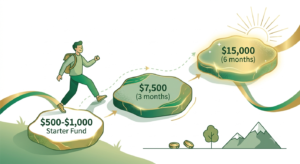
If you’re starting from zero or you’re currently in debt, your first goal should be a “starter” emergency fund of $500 to $1,000. This amount won’t cover every possible emergency, but it handles the most common ones—a minor car repair, a broken appliance, a small medical copay, or an urgent pet vet visit.
This starter fund serves a critical purpose: it protects you from going deeper into debt while you’re working on paying off existing debt. Think of it as the foundation that keeps your debt payoff plan from collapsing when life happens.
The Full Emergency Fund: 3 to 6 Months of Expenses
Once you’ve paid off high-interest debt (or if you don’t have debt), your target should be a full emergency fund covering three to six months of essential living expenses. Notice I said expenses, not income. You don’t need to replace your entire salary—you need enough to cover your bills, food, insurance, and other necessities if your income suddenly stopped.
Three months is the minimum if you have stable employment, dual income in your household, or you could easily find another job in your field.
Six months (or more) makes sense if you’re self-employed, work in a volatile industry, are the sole earner in your household, or have health concerns that could affect your ability to work.
How to Calculate Your Number
Here’s a simple formula: Add up all your monthly essential expenses—rent or mortgage, utilities, groceries, insurance, minimum debt payments, transportation, and basic necessities. Multiply that total by either 3 or 6, depending on your situation. That’s your full emergency fund goal.
For example, if your essential monthly expenses total $2,500, your emergency fund goal should be $7,500 (3 months) to $15,000 (6 months).
Don’t let these larger numbers intimidate you. You don’t build this overnight. You build it dollar by dollar, month by month, with a clear plan—which is exactly what we’ll cover next.
Where to Keep Your Emergency Fund
Location matters. Your emergency fund needs to be accessible but not too accessible. Here’s how to strike that balance.
High-Yield Savings Account: The Best Choice
A high-yield savings account is the ideal home for your emergency fund. These accounts, typically offered by online banks, pay significantly higher interest rates than traditional savings accounts—often 10 to 20 times more—while still keeping your money completely liquid and FDIC-insured.
As of 2026, competitive high-yield savings accounts are paying around 4% to 5% APY, meaning your emergency fund actually grows while it sits there protecting you. Compare that to the 0.01% to 0.50% you’d earn at a traditional brick-and-mortar bank, and the choice is clear.
Our guide on high-yield savings accounts compares the top options currently available, with details on rates, minimums, and features.
Money Market Accounts: A Close Alternative
Money market accounts are another solid option. They typically offer similar interest rates to high-yield savings accounts, but may come with check-writing privileges or debit card access for even easier access in emergencies. Some people prefer this hybrid approach.
Where NOT to Keep Your Emergency Fund
Regular checking account: Too accessible—you’ll be tempted to spend it on non-emergencies, and it earns almost no interest.
Investment accounts: Too risky and not liquid enough. If the market drops 20% the same week you need your emergency money, you’re forced to sell at a loss. Emergency funds should never be invested in stocks or bonds.
Cash at home: Earns zero interest, can be stolen, and creates too much temptation to dip into it.
CDs or other locked accounts: Not liquid enough. You can’t access the money quickly without paying penalties.
The perfect emergency fund is in a separate account that’s easy to access in a true emergency, but just inconvenient enough that you won’t casually dip into it for wants.
Step-by-Step: How to Build Your Emergency Fund
Now for the action plan. Here’s exactly how to go from zero to fully funded.
Step 1: Set Your Initial Goal
Start with that $500 to $1,000 starter emergency fund. Don’t worry about the full 3-6 months yet—that comes later. Breaking this into stages prevents overwhelm and gives you achievable milestones to celebrate along the way.
Step 2: Create a Budget to Find Savings
You can’t save what you don’t have, so you need to find money in your existing budget to allocate toward your emergency fund. This starts with understanding exactly where your money currently goes.
Track your spending for a full month using our guide on how to track your expenses effectively. Then build a budget using either the beginner-friendly 50/30/20 rule or the more detailed zero-based budgeting method. Both approaches will reveal money you didn’t realize you had available.
Even finding $25 per week—which is $100 per month—gets you to $1,000 in just ten months. That might feel slow, but it’s infinitely better than the zero you have right now.
Step 3: Automate Your Savings
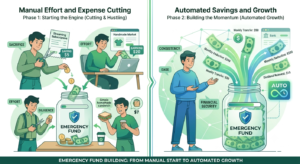
The biggest mistake people make with emergency funds is trying to save “whatever’s left over” at the end of the month. There’s never anything left over. Instead, automate a transfer from your checking account to your emergency fund savings account the day after each paycheck hits.
Treat your emergency fund contribution like a bill that must be paid. Make it automatic so it happens whether you feel like it or not. Our complete guide on how to automate your finances walks through the setup process step by step.
Step 4: Cut Expenses Temporarily
Building your initial emergency fund is worth some short-term sacrifice. Look for expenses you can cut or reduce temporarily:
- Cancel subscriptions you’re not actively using
- Cook at home instead of eating out for the next few months
- Postpone non-essential purchases
- Find free entertainment instead of paid activities
- Shop your existing closet instead of buying new clothes
These aren’t permanent lifestyle changes—they’re focused, temporary measures to reach your $500 or $1,000 starter goal faster. Once you hit that milestone, you can ease up slightly while continuing to build toward your full fund.
Step 5: Boost Your Income
Cutting expenses has a ceiling. Earning more money doesn’t. Even a small side income stream can dramatically accelerate your emergency fund progress.
Consider taking on a temporary side hustle—freelancing a skill you already have, driving for a rideshare service a few hours per week, selling items you no longer need, or picking up seasonal work. Check out our list of side hustle ideas that pay $500+ per month for specific, actionable options.
The beauty of side hustle income is that it’s “extra” money that doesn’t support your regular lifestyle. Every dollar from it can go straight to your emergency fund without feeling like sacrifice.
Step 6: Use Windfalls Strategically
Tax refunds, work bonuses, gifts, rebates, or any other unexpected money should go directly to your emergency fund until you hit your goal. These windfalls can cut months or even years off your timeline.
Step 7: Celebrate Milestones, Then Keep Going
When you hit $500, celebrate—that’s a real achievement. Then aim for $1,000. Once you reach your starter fund and you’ve paid off high-interest debt, start building toward your full 3-6 month emergency fund using the same strategies.
Building an Emergency Fund on a Low Income
If money is extremely tight, building an emergency fund feels nearly impossible. But it’s not—it just requires different strategies.
Start Even Smaller
If $500 feels unreachable, start with $250 or even $100. Any emergency fund is better than none. A $100 buffer has saved countless people from overdraft fees or payday loans—both of which cost far more than $100.
Use the Micro-Savings Approach
Save in tiny increments that don’t hurt: $5 per week is $260 per year. $10 per week is $520. $1 per day is $365. These amounts feel manageable even on the tightest budget, and they add up faster than you’d expect.
Take Advantage of Round-Up Apps
Several apps automatically round up your purchases to the nearest dollar and save the difference. These “invisible” savings work well for people who struggle with traditional saving because you barely notice the money leaving.
Challenge Your “Fixed” Expenses
Many expenses that feel fixed actually aren’t. Can you switch to a cheaper phone plan? Bundle insurance policies for a discount? Find a roommate to split rent? Apply for assistance programs you qualify for? These bigger moves can free up $50 to $100 or more per month.
Focus on Free Money First
Before cutting your budget to the bone, make sure you’re not leaving free money on the table. Are you getting the full employer match on your 401(k)? That’s free money—though building your starter emergency fund should come before contributing beyond the match. Are you claiming all the tax credits and deductions you qualify for? Check whether you’re eligible for programs like SNAP, utility assistance, or healthcare subsidies.
How to Protect Your Emergency Fund Once You’ve Built It
Building the fund is hard. Protecting it from yourself is sometimes harder.
Define What Counts as an Emergency
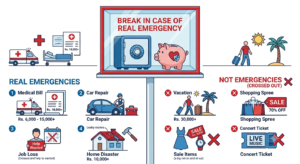
The biggest threat to your emergency fund is loose definitions. “Emergency” doesn’t mean “I really want it” or “it’s on sale.” Real emergencies are unexpected, necessary, and urgent.
True emergencies: Job loss, medical crisis, essential car or home repairs, urgent pet care, replacing broken essentials.
Not emergencies: Vacations, holiday gifts, new clothes, wants you can save for separately, predictable annual expenses.
Create a Sinking Fund for Predictable Expenses
Many people raid their emergency fund for expenses that aren’t actually emergencies—they’re just irregular bills. Car insurance due every six months isn’t an emergency—it’s predictable.
Set up a separate “sinking fund” for these known irregular expenses. Calculate your annual predictable expenses (insurance premiums, car registration, holiday spending, home maintenance), divide by 12, and save that amount monthly in a separate account. This protects your true emergency fund from being depleted by things you should have planned for.
Replenish Immediately After Using It
If you do need to tap your emergency fund, make replenishing it your top priority. Redirect all available extra money back to the fund until it’s whole again. Without this discipline, your emergency fund slowly disappears and you’re back to being vulnerable.
Keep It Separate and Slightly Inconvenient
Don’t link your emergency fund to your checking account for overdraft protection. Don’t keep a debit card for it. Make accessing the money require a deliberate transfer that takes a day or two. This small friction prevents impulsive “emergencies” while still keeping the money accessible when you truly need it.
Common Mistakes That Sabotage Emergency Funds
Avoid these pitfalls that derail even the best intentions.
Mistake 1: Waiting Until You “Can Afford It”
You’ll never feel like you can afford to save. There will always be something else that feels more urgent. The only way to build an emergency fund is to start now with whatever amount you can manage, even if it’s tiny.
Mistake 2: Saving in the Wrong Place
Earning 0.01% interest when you could earn 4-5% in a high-yield account means you’re leaving free money on the table. Don’t be lazy about where your emergency fund lives.
Mistake 3: Prioritizing Investing Over Emergency Savings
Yes, investing typically earns higher returns than savings accounts. But without an emergency fund, you’ll be forced to sell those investments at the worst possible time—during a market downturn or personal crisis. Build your emergency fund first, then invest aggressively.
Mistake 4: Confusing Your Emergency Fund With Debt Payoff
Here’s the common dilemma: should you build an emergency fund or pay off debt first? The answer is both, but in stages. Build your $500-$1,000 starter fund first, then attack high-interest debt, then build your full emergency fund. This sequence prevents new debt while eliminating existing debt. Our guide on debt consolidation vs debt settlement can help you tackle the debt side of this equation.
Mistake 5: Giving Up After Setbacks
You’ll dip into your emergency fund. That’s what it’s for. Don’t interpret using it as failure—that’s success. The system is working. Just commit to rebuilding it afterward.
What to Do After Your Emergency Fund Is Complete
Once you’ve reached your full 3-6 month emergency fund goal, congratulations—you’ve achieved what most Americans never do. But your financial journey doesn’t end here. Here’s what comes next.
Keep Your Fund Topped Off
Review your emergency fund once or twice a year. If your expenses have increased, your fund should grow proportionally. If you get a raise, adjust your target upward.
Redirect Your Savings to Other Goals
The money you were putting into your emergency fund doesn’t disappear—it just gets redirected. Now you can focus on:
- Maxing out retirement contributions
- Saving for a home down payment
- Building a college fund
- Investing in taxable accountshttps://finance4you.online/save-10000-in-one-year/
- Saving for other major goals
Check out our guide on how to save $10,000 in one year for your next savings challenge.
Consider Slightly Higher-Yield Options
Once your emergency fund is fully funded, you might move three months’ worth into a slightly higher-yield but still liquid option like a money market account, while keeping three months in your regular high-yield savings for immediate access. This squeezes a bit more return out of your safety net.
othes ideas
https://finance4you.online/how-to-build-emergency-fund/
https://finance4you.online/best-high-yield-savings-accounts/
https://finance4you.online/money-market-account-vs-savings-account/
https://finance4you.online/save-10000-in-one-year/
Frequently Asked Questions
How long does it take to build an emergency fund?
It depends entirely on your income, expenses, and how aggressively you save. At $100 per month, you’ll reach $1,000 in 10 months. At $500 per month, you’ll hit $6,000 in a year. Focus on consistency, not speed—every dollar you save is progress.
Can I use my credit card as an emergency fund?
No. A credit card is not an emergency fund—it’s debt waiting to happen. You’ll pay interest on every dollar you borrow, potentially at rates above 20%, and you’re not building a financial cushion—you’re just shifting the crisis from today to next month’s bill.
Should I build my emergency fund or pay off debt first?
Build a small starter emergency fund of $500-$1,000 first, then focus on paying off high-interest debt, then build your full 3-6 month emergency fund. This prevents you from going deeper into debt when emergencies hit while you’re working on existing balances.
What if I can only save $10 or $20 a month?
Then save $10 or $20 a month. That’s $120 to $240 per year, which is infinitely better than zero. Small amounts compound into real money over time, and the habit you’re building is more valuable than the initial dollar amount.
Where’s the best place to keep my emergency fund?
A high-yield savings account at an online bank is the ideal spot. It earns meaningful interest (4-5% as of 2026), keeps your money liquid and accessible, and is FDIC-insured up to $250,000. Our comparison of high-yield savings accounts shows the current best options.
How do I rebuild my emergency fund after using it?
Treat rebuilding like building it the first time. Immediately redirect your monthly savings back to the emergency fund until it’s whole again. Pause other financial goals temporarily if needed—having that safety net restored should be your top priority.
Conclusion: Your Financial Safety Net Starts Today
An emergency fund isn’t sexy or exciting. It won’t make you rich, and you can’t show it off. But it’s the difference between weathering life’s storms with confidence and drowning in debt and stress every time something goes wrong.
Every dollar you put into your emergency fund is a vote for your future security. It’s choosing peace over panic, stability over chaos, and freedom over financial fragility. It might feel slow at first, especially if you’re starting with $25 or $50 per month. But time passes whether you’re saving or not—wouldn’t you rather look back a year from now and have $600 saved than zero?
Start where you are. Save what you can. Automate it so it happens without willpower. And protect it fiercely once you’ve built it. Your future self—the one who faces an unexpected expense without panic—will thank you for the foundation you’re building today.
Ready to take control of your financial security? Start by building a budget that reveals money for savings with our 50/30/20 rule guide or zero-based budgeting method, then learn how to track your expenses effectively to find extra dollars hiding in your spending. Set up automation with our guide on how to automate your finances, and if you need extra income to reach your goal faster, browse our side hustle ideas that pay $500+ per month. Your emergency fund—and the financial peace it brings—is within your reach.
Disclaimer: This article is for informational purposes only and does not constitute financial advice. Everyone’s financial situation is unique. Consider consulting a qualified financial advisor for personalized guidance.