
Introduction
Let me ask you a blunt question: how much interest did your savings account earn you last month? If you’re like most Americans keeping money in a traditional brick-and-mortar bank, the answer is probably somewhere between embarrassingly little and practically nothing.
Here’s the harsh reality: if you’re keeping your hard-earned savings in a traditional bank account earning 0.01% to 0.05% interest, you’re essentially working for free. Every day your money sits there, inflation quietly eats away at its purchasing power while your bank turns around and lends that same money out at rates 100 times higher than what they’re paying you.
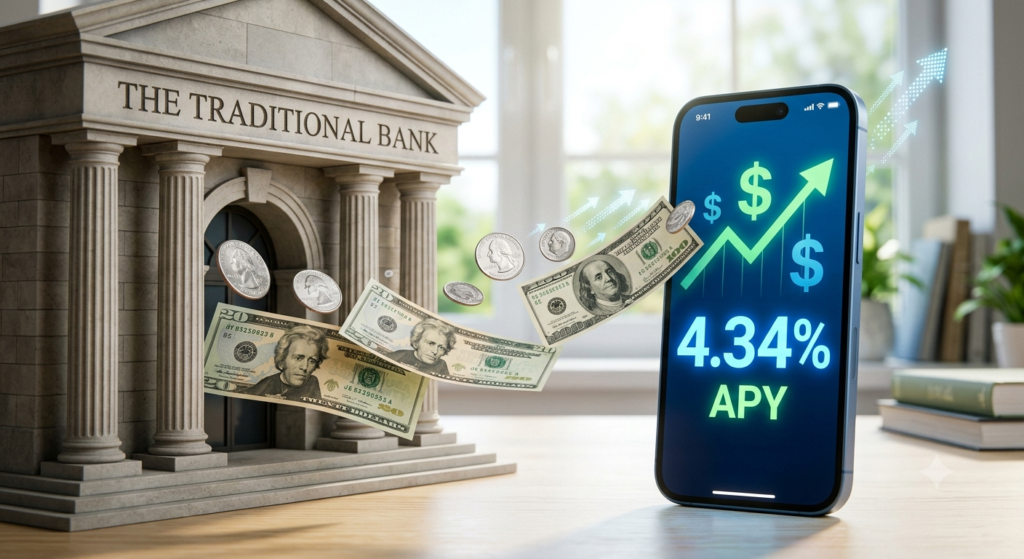
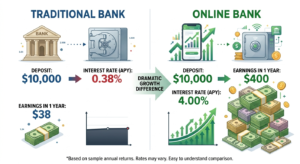
Let’s put some real numbers on this. As of August 2026, the national average savings rate sits at a pathetic 0.38% according to the FDIC. That means on a $10,000 emergency fund—money you worked hard to save and might need at any moment—you’d earn a whopping $38 in interest over an entire year. Before taxes.
Meanwhile, the best high-yield savings accounts available right now are paying between 4.00% and 4.34% APY. That’s the same $10,000 earning $400 to $434 per year instead. Over five years, that’s the difference between earning $190 versus over $2,200. Same money. Same safety. Wildly different results.
And here’s what makes this even more frustrating: switching to a high-yield savings account is probably the easiest money you’ll ever make. There’s no complicated investing strategy to learn, no market risk to worry about, no long-term lockup of your funds, and no reduction in safety. Your money remains completely liquid, completely accessible, and completely FDIC-insured up to $250,000.
You’re literally just choosing to earn what your savings actually deserve instead of letting a traditional bank profit from your financial inertia.https://finance4you.online/student-loan-forgiveness-guide/
In this comprehensive guide, I’ll walk you through the 15 best high-yield savings accounts available in 2026, compare their rates and features side by side, explain exactly what to look for, and help you choose the perfect account for your emergency fund, short-term savings goals, or any cash you want to keep safe and accessible. By the end, you’ll know exactly where to move your money to start earning 10 to 20 times more interest than you’re getting now.
Let’s make your money work as hard as you do.
What Exactly Is a High-Yield Savings Account?
Before we dive into comparing specific accounts, let’s make sure we’re all on the same page about what we’re actually discussing and why these accounts matter.
The Simple Definition
A high-yield savings account is exactly what it sounds like: a savings account that pays significantly higher interest rates than the national average. Specifically, these accounts typically offer annual percentage yields (APYs) that are 10 to 20 times—sometimes even more—than what traditional banks pay.
The mechanics are identical to a regular savings account. You deposit money, it sits there safely, you can withdraw it whenever you need it, and you earn interest on your balance. The only difference is the rate at which that interest accumulates.
Why the “High-Yield” Designation Matters
The term “high-yield” is relative to the broader market. When the national average for savings accounts hovers around 0.38%, an account paying 4.00% or higher absolutely qualifies as high-yield. That’s not marketing speak—it’s a legitimate 10x difference in what your money earns.
This distinction becomes crucial when you’re deciding where to park your emergency fund or short-term savings. The difference between high-yield and average isn’t academic—it’s hundreds or thousands of dollars in your pocket versus the bank’s.
How Online Banks Can Afford to Pay So Much More
This is the question everyone asks, and the answer reveals why traditional banks have gotten away with paying so little for so long.
Online banks can offer significantly higher interest rates because they operate with dramatically lower overhead costs. Think about what a traditional bank pays for: physical branch locations with expensive real estate, utilities, security, maintenance, branch managers, tellers, and all the infrastructure that comes with in-person banking.
Online banks eliminate virtually all of these costs. No branches means no rent, no utility bills, no on-site staff. They can operate with a fraction of the employees, passing those savings directly to customers in the form of higher interest rates and lower fees.
This isn’t a gimmick or a temporary promotion—it’s a fundamental business model difference. As long as online banks maintain lower costs, they can sustainably pay higher rates than their brick-and-mortar competitors.
But Wait—Is My Money Actually Safe?
This is the most important question, and I want to address it head-on because it’s the main reason people hesitate to move their money to an online bank they’ve never heard of.
The answer is an unequivocal yes—as long as you choose an FDIC-insured bank or NCUA-insured credit union.
If your bank is insured by the FDIC or your credit union is insured by the National Credit Union Administration, then your savings are federally insured to at least $250,000. This protection is backed by the full faith and credit of the U.S. government. Even if the bank completely fails, your money is protected up to the coverage limit.
Every account on our list is fully FDIC or NCUA insured. Your money is exactly as safe as it would be at the big traditional bank down the street—you’re just earning 10 times more interest on it.
The bottom line: A high-yield savings account at a reputable online bank gives you the same safety and liquidity as a traditional savings account, just with dramatically better returns.
Understanding the Current Rate Environment (August 2026)
Before we compare specific accounts, it helps to understand the
broader context of where savings rates are right now and where they might be heading.
Where Rates Stand Today
As of August 2026, we’re in an interesting moment for savers. High-yield savings account rates remain strong compared to historical standards, though they’ve been slowly trending downward from their recent peaks.
The Federal Reserve plays a crucial role in this story. On July 29, 2026, the Federal Reserve announced that it would leave the federal funds rate unchanged, maintaining the target range between 3.50% and 3.75%. This decision signals a pause in the Fed’s rate cycle after years of adjustments.
For savers, this stable Fed policy has meant relatively steady—though slowly declining—rates throughout mid-2026. Since early June, we’ve tracked 13 accounts on our list that changed rates, with 10 lowering their APYs and three raising them.
What “Competitive” Looks Like Right Now
So what should you actually expect from a high-yield savings account in August 2026?
As of July 30, 2026, top high-yield savings accounts are offering up to 4.50% APY—and that blows away the FDIC’s national average of 0.38%. Here’s how to evaluate offers:
Excellent: 4.20% to 4.50% APY
Very Good: 3.80% to 4.19% APY
Good: 3.50% to 3.79% APY
Average (but still better than traditional banks): 3.00% to 3.49% APY
Any account offering 4.00% or higher in August 2026 is genuinely competitive and worth considering. Anything below 3.00% is falling behind the market, and anything below 1.00% is essentially a traditional bank account masquerading as high-yield.
Rate Trends: What to Expect Going Forward
While nobody has a crystal ball, understanding the likely trajectory helps you make informed decisions.
Most financial analysts expect high-yield savings rates to gradually decline through the remainder of 2026 and into 2027 if the Fed begins cutting rates, as many economists predict. This doesn’t mean rates will collapse overnight—changes happen gradually—but it does suggest that the 4%+ rates we’re seeing now may not last forever.
The practical implication? If you’ve been procrastinating on moving your money to a high-yield account, now is better than later. Even if rates do decline somewhat, you’ll still be earning far more than in a traditional account.
The 15 Best High-Yield Savings Accounts of 2026: Detailed Comparison
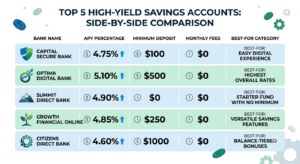
Now let’s get to what you came for: the actual accounts ranked and compared. I’ve organized these by categories that reflect different priorities—highest rate, best features, most accessible, and so on.
1. Elevault High-Yield Savings — Best Overall Pick
APY: 4.34%
Minimum Deposit to Open: $0
Monthly Maintenance Fee: $0
Minimum Balance to Earn APY: $0.01
Maximum Balance Eligible for APY: $500,000
The Elevault High-Yield Savings account takes our top overall spot because it combines an excellent rate with zero barriers to entry. At 4.34% APY—one of the highest available—you’re maximizing your returns without jumping through hoops.
What sets Elevault apart is its simplicity. There are no minimum deposit requirements, no monthly fees, and no complicated requirements to hit the advertised rate. You can open an account with $1 and immediately start earning 4.34% on every dollar.
The $500,000 cap on the high APY is generous enough that it won’t affect most savers. If you’re lucky enough to have more than that in savings, you’d want to spread it across multiple institutions for FDIC coverage anyway.
Pros:
- Among the highest APYs available (4.34%)
- No minimum deposit or balance requirements
- No monthly maintenance fees
- Straightforward—what you see is what you get
Cons:
- Online-only access (no physical branches)
- Relatively new bank with less name recognition
- APY applies only to first $500,000
Best for: Most savers looking for the best combination of rate and simplicity.
2. Newtek Bank Personal High Yield Savings — Highest Rated (Waitlist)
APY: 4.20%
Minimum Deposit to Open: $0
Monthly Maintenance Fee: $0
Current Status: Waitlist only
Newtek Bank’s Personal High Yield Savings was selected as the best savings account in NerdWallet’s 2026 Best-Of Awards, a recognition it earned through consistently competitive rates and customer satisfaction.
At 4.20% APY with no fees and no minimums, it’s an excellent account—when you can get it. Here’s the catch: due to “overwhelming demand,” Newtek is currently not accepting new applications. You can join a waitlist through their website, but there’s no guarantee of when (or if) you’ll get access.
Pros:
- Recognized as best-in-class by major financial publishers
- Excellent 4.20% APY
- No fees or minimum requirements when you can get in
Cons:
- Currently closed to new applicants
- Uncertain waitlist timeline
- You’re better off opening an available account now than waiting indefinitely
Best for: Savers willing to join a waitlist while keeping money elsewhere in the meantime.
3. SoFi Checking and Savings — Best for Banking Relationship
APY: 4.00% (when you set up direct deposit)
Minimum Deposit to Open: $0
Monthly Maintenance Fee: $0
SoFi stands out not just for its competitive rate but for bundling checking and savings into a single, cohesive banking relationship. This account pays 4.00% APY—but only if you set up direct deposit or deposit $5,000+ per month.
Beyond the savings rate, SoFi offers an integrated checking account with no account fees, no overdraft fees, and access to a nationwide network of fee-free ATMs. If you’re looking to replace your traditional bank entirely rather than just opening a savings account, SoFi makes a compelling case.
Additional perks include early direct deposit (get your paycheck up to two days early), automatic savings tools, and financial planning resources.
Pros:
- Excellent 4.00% rate (with direct deposit)
- Integrated checking and savings
- No fees of any kind—monthly, overdraft, or otherwise
- Strong mobile app and customer experience
- Access to 55,000+ fee-free ATMs
Cons:
- Rate requires direct deposit or $5,000/month deposits
- Without qualifying activity, the rate drops significantly
- Not ideal if you want savings-only without a checking account
Best for: People looking to replace their traditional bank with a full-service online alternative.
4. American Express® High Yield Savings — Best Brand Recognition
APY: 4.00%
Minimum Deposit to Open: $0
Monthly Maintenance Fee: $0
If you’re hesitant about banking with an institution you’ve never heard of, American Express offers the comfort of a globally recognized brand combined with a genuinely competitive 4.00% APY.
AmEx’s high-yield savings account operates separately from their credit card business but carries the same reputation for customer service and reliability. The account is straightforward: no minimums, no fees, and the full 4.00% APY from dollar one.
The user experience is polished, with an intuitive mobile app and easy linking to external accounts for transfers. You can move money in and out quickly, and American Express’s strong customer service means help is available when you need it.
Pros:
- Trusted, well-known brand
- Competitive 4.00% APY
- No minimum balance or deposit requirements
- Strong customer service reputation
- Easy-to-use mobile app
Cons:
- Rate is slightly below the absolute highest available
- Some competing online banks pay a bit more
- Online-only (though that’s true for most high-yield options)
Best for: Savers who want the highest rate from a name they recognize and trust.
5. Marcus by Goldman Sachs High-Yield Online Savings — Best for Customer Service
APY: 4.00%
Minimum Deposit to Open: $0
Monthly Maintenance Fee: $0
Marcus by Goldman Sachs brings Wall Street expertise to consumer banking, and it shows in their customer-focused approach. While the 4.00% APY matches several competitors, Marcus distinguishes itself through exceptional customer service and a track record of competitive rates over time.
The account offers no minimums, no fees, and full FDIC insurance. What sets Marcus apart is accessibility: while it’s primarily an online bank, they offer phone support with actual humans who can help you—a rarity in the online banking world where most competitors route you through chatbots and email.
Marcus also offers rate guarantees on certain promotions and has historically been quick to raise rates when the Fed moves, meaning you’re less likely to fall behind the market.
Pros:
- Strong 4.00% APY
- Exceptional customer service with real phone support
- No minimums or monthly fees
- Backed by Goldman Sachs’ financial strength
- Historically quick to adjust rates upward
Cons:
- APY is competitive but not the absolute highest
- Online-only access to your funds
- No checking account option (savings only)
Best for: Savers who value responsive customer service alongside competitive rates.
6. Ally Bank Online Savings Account — Best for Accessibility and Features
APY: 3.90%
Minimum Deposit to Open: $0
Monthly Maintenance Fee: $0
Ally Bank has been a pioneer in online banking for years, and their savings account reflects that experience. While the 3.90% APY is slightly below the top tier, Ally compensates with an exceptional suite of features and accessibility options.
Ally offers more flexibility than most competitors: buckets for organizing savings goals within your account, easy external transfers, Zelle integration for quick peer-to-peer payments, and a best-in-class mobile app. They also offer a full checking account that integrates seamlessly with savings if you want a complete banking relationship.
Customer service is available 24/7 by phone, and Ally has consistently maintained competitive rates even as some competitors have dropped theirs.
Pros:
- Excellent features and user experience
- Savings buckets for goal organization
- 24/7 customer service
- No fees or minimums
- Full-service bank (checking, investing, etc.)
Cons:
- 3.90% APY is good but trails the leaders by about 0.40%
- On a large balance, that difference adds up over time
Best for: Savers who want a feature-rich experience and potential full banking relationship, even if it means sacrificing a small amount of yield.
7. CIT Bank Platinum Savings — Best for Larger Balances
APY: 4.25% (on balances of $5,000+)
Minimum Deposit to Open: $100
Monthly Maintenance Fee: $0
CIT Bank’s Platinum Savings account offers one of the highest APYs available—4.25%—but with a catch: you need to maintain a balance of at least $5,000 to earn it. If your balance drops below that threshold, your rate falls to just 1.00%.
For savers with established emergency funds or substantial savings, this trade-off makes sense. The 4.25% rate is excellent, and the $5,000 minimum isn’t unreasonably high. But for someone just starting to build savings, the cliff at $5,000 makes this account less appealing than options with no minimum.
Pros:
- Excellent 4.25% APY on balances of $5,000+
- No monthly fees
- Strong rate for those who qualify
Cons:
- $100 minimum to open
- Rate drops dramatically to 1.00% if balance falls below $5,000
- Not ideal for small or growing emergency funds
Best for: Savers with at least $5,000 who want to maximize their rate on an established fund.
8. Barclays Online Savings Account — Best for Simplicity
APY: 4.00%
Minimum Deposit to Open: $0
Monthly Maintenance Fee: $0
Barclays keeps things refreshingly simple: open an account with no minimum, maintain no minimum balance, pay no fees, and earn 4.00% APY on every dollar. That’s it.
There are no tiers, no requirements to qualify, no buckets or bells and whistles—just a straightforward, competitive savings account from an established international bank.
If you want simplicity without sacrificing rate, Barclays delivers.
Pros:
- Clean 4.00% APY with no strings attached
- No minimums or fees
- Established bank with strong reputation
- Easy to understand and use
Cons:
- No additional features or tools
- Online-only
- Rate is competitive but not the absolute highest
Best for: Savers who want straightforward, no-nonsense high-yield savings.
9. UFB Direct High-Yield Savings — High Rate for Those Who Qualify
APY: 4.31%
Minimum Deposit to Open: $0
Monthly Maintenance Fee: $0
UFB Direct offers one of the highest APYs on the market at 4.31%, making it extremely competitive with our top pick. There are no monthly fees and no minimum deposit to open.
The account is straightforward and offers easy transfers, mobile check deposit, and FDIC insurance. UFB Direct is the online brand of Axos Bank, giving it the backing of an established financial institution.
Pros:
- Very high 4.31% APY
- No minimums or monthly fees
- Mobile check deposit available
- Backed by Axos Bank
Cons:
- Less name recognition than some competitors
- Fewer features than full-service banks like Ally
- Online-only access
Best for: Rate-focused savers who want near-top yields without complicated requirements.
10. Synchrony Bank High Yield Savings — No Minimums, Solid Rate
APY: 4.00%
Minimum Deposit to Open: $0
Monthly Maintenance Fee: $0
Synchrony Bank has been in the high-yield savings space for years, and their account offers a solid 4.00% APY with zero minimums or fees. While it doesn’t stand out dramatically in any single area, it’s a reliable, well-rounded option.
Synchrony offers an optional ATM card for your savings account, which is unusual and can provide extra convenience for accessing your money in emergencies. They also have 24/7 phone customer service.
Pros:
- Competitive 4.00% APY
- Optional ATM card for easier access
- No minimums or fees
- Established online bank with long track record
Cons:
- No standout features or highest-in-market rate
- Online-only
- Rate matches but doesn’t beat many competitors
Best for: Savers who want the option of ATM card access to their savings.
11. Discover Online Savings Account — Best for Existing Discover Customers
APY: 3.90%
Minimum Deposit to Open: $0
Monthly Maintenance Fee: $0
Discover is best known for credit cards, but their online savings account is genuinely competitive at 3.90% APY. If you already have a Discover credit card, adding a savings account integrates smoothly into your existing relationship.
The account has no fees, no minimums, and easy transfers. Discover also offers phone customer service with U.S.-based representatives, which is increasingly rare.
Pros:
- Solid 3.90% rate
- Integrates with existing Discover products
- No fees or minimums
- U.S.-based customer service
Cons:
- APY trails the leaders
- Online-only
- No particular advantage unless you’re already a Discover customer
Best for: Current Discover credit card holders looking to consolidate accounts.
12. Capital One 360 Performance Savings — Best for Full Banking
APY: 3.90%
Minimum Deposit to Open: $0
Monthly Maintenance Fee: $0
Capital One’s 360 Performance Savings offers a competitive 3.90% APY alongside the option to add checking accounts, investment accounts, and even physical branch access through Capital One Cafés in select cities.
If you want the benefits of online banking with the occasional option for in-person help, Capital One provides a unique middle ground.
Pros:
- Competitive 3.90% rate
- Optional in-person branch access through Capital One Cafés
- Full suite of banking products
- No fees or minimums
Cons:
- Rate slightly below the top tier
- Full benefits only available if you want the broader relationship
Best for: Savers who want high-yield rates but occasionally value in-person access.
13. Citizens Access® Online Savings Account — Strong Rate, Established Bank
APY: 4.00%
Minimum Deposit to Open: $0.01
Monthly Maintenance Fee: $0
Citizens Access is the online division of Citizens Bank, one of the oldest banks in America. Their online savings account offers a strong 4.00% APY backed by the reputation of a major regional bank.
The account is straightforward with no fees and minimal opening requirements. If you value the backing of an established institution, Citizens provides that alongside competitive online rates.
Pros:
- Solid 4.00% APY
- Backed by established regional bank
- No fees
- Virtually no minimum ($0.01 to open)
Cons:
- Few distinguishing features
- Online-only despite traditional bank backing
Best for: Savers who want online rates with traditional bank backing.
14. BMO Alto Online Savings Account — High Rate, Big Bank
APY: 4.10%
Minimum Deposit to Open: $0
Monthly Maintenance Fee: $0
BMO Alto is BMO Bank’s online-only offering, and it delivers a competitive 4.10% APY with no fees or minimums. This is a pure high-yield savings account without checking or other products attached.
BMO is a major North American bank, giving Alto the benefit of strong backing and financial stability.
Pros:
- Strong 4.10% rate
- Backed by major bank (BMO)
- No fees or minimums
- Simple and focused on savings
Cons:
- Online-only
- No additional products or features
- Newer brand with less track record
Best for: Savers who want a high rate from a major bank institution.
15. TAB Bank High Yield Savings — Solid Option for Simplicity
APY: 4.06%
Minimum Deposit to Open: $0
Monthly Maintenance Fee: $0
TAB Bank rounds out our list with a competitive 4.06% APY and straightforward terms. While not the highest rate available, it’s a reliable option with no complicated requirements.
Pros:
- Good 4.06% rate
- No fees or minimums
- Straightforward terms
Cons:
- Lesser-known institution
- No standout features
- Online-only
Best for: Rate-focused savers comfortable with smaller institutions.
https://finance4you.online/best-high-yield-savings-accounts/
What to Look for When Choosing a High-Yield Savings Account
With 15 solid options, how do you actually decide? Here are the factors that matter most.
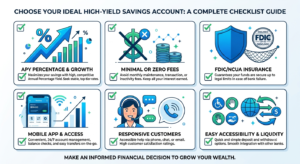
APY: The Most Important Factor (But Not the Only One)
Annual percentage yield is your starting point. It directly determines how much your money earns, so obviously higher is better. In August 2026, anything above 4.00% is excellent.
However, don’t chase an extra 0.10% at the expense of everything else. The difference between 4.20% and 4.30% on a $10,000 balance is $10 per year—meaningful, yes, but not worth sacrificing important features or accepting terrible customer service.
Fees: Ideally Zero
Every account on our list has $0 monthly maintenance fees, and that should be your minimum standard. High-yield savings accounts that charge monthly fees are usually not worth it—the fee often negates the higher interest you’d earn.
Also watch for:
- Transfer fees
- Excessive withdrawal fees beyond the federal limit
- Minimum balance fees
- Account closure fees
The best accounts have none of these.
Minimum Deposit and Balance Requirements
Accounts with no minimums are the most accessible, especially if you’re just starting to build savings. Some accounts offer higher rates but require $5,000 or more to earn them—fine if you have that, problematic if you don’t.
Pay attention to whether the minimum is just to open the account or to earn the advertised APY. An account with a $100 opening minimum but no ongoing requirement is very different from one requiring a $5,000 balance to earn the high rate.
FDIC or NCUA Insurance: Non-Negotiable
Never keep money in an account that isn’t FDIC-insured (banks) or NCUA-insured (credit unions). This protection guarantees your deposits up to $250,000 even if the institution fails completely.
Every account on our list carries this insurance. If you ever consider an account not on this list, verify insurance before depositing a single dollar.
Ease of Access: How Quickly Can You Get Your Money?
High-yield savings accounts are designed to be liquid—you should be able to access your money relatively quickly when you need it. Look for:
- Transfer times: How long does it take to transfer money to your external checking account? Same day? Next day? 3-5 business days?
- Transfer methods: Can you only do ACH transfers, or are there other options like wire transfers or ATM access?
- Withdrawal limits: While federal rules limit certain withdrawals to six per month, some banks impose additional restrictions.
Your emergency fund needs to actually be accessible in an emergency. Choose an account that makes that easy.
Customer Service: Helpful When Things Go Wrong
Online banking is convenient until something goes wrong. When you need help, does the bank offer:
- Phone support? Live chat? Email only?
- 24/7 availability or limited hours?
- U.S.-based representatives or overseas call centers?
- Positive reviews about actually solving problems?
You hopefully won’t need customer service often, but when you do, quality matters.
Mobile App Experience
Since you’re banking online, the mobile app becomes your primary interface. Check reviews for:
- Ease of use and intuitive design
- Mobile check deposit capabilities
- Fingerprint or face ID login
- Clear transaction history
- Push notifications for deposits and large transactions
A clunky app makes online banking frustrating. A great app makes it effortless.
Additional Features That Matter
Depending on your needs, consider:
- Savings buckets or goals: Can you organize your savings into different purposes within one account?
- Automatic savings tools: Does the app offer round-ups or scheduled transfers?
- Multiple linked accounts: Can you link to external banks for easy transfers?
- Paper check access: Do you get checks or an ATM card for emergency access?
How to Open a High-Yield Savings Account (Step-by-Step)
Ready to make the switch? Here’s exactly how to open your account and start earning more.
Step 1: Choose Your Account
Based on the comparisons above and your priorities, select the account that best fits your needs. For most people, the highest APY with zero fees and no minimums is the sweet spot—which currently points to Elevault or UFB Direct.
Step 2: Gather Required Information
Before starting your application, have these items ready:
- Social Security number or Individual Taxpayer Identification Number
- Government-issued photo ID (driver’s license or passport)
- Personal information (address, phone number, email)
- Employment information (some banks ask)
- Funding source information if making an initial deposit
Step 3: Complete the Online Application
Most applications take 10-15 minutes. You’ll provide your personal information, agree to terms, and verify your identity. Some banks offer instant approval, while others may take 1-2 business days to review.
Step 4: Fund Your Account
You can typically fund your new account by:
- Linking an external bank account and transferring money
- Making a mobile check deposit
- Mailing a physical check
- Setting up direct deposit from your employer
If you’re moving a substantial amount from another savings account, the transfer might take 3-5 business days, so plan accordingly.
Step 5: Set Up Automatic Transfers
This is the step most people skip—and it’s the most important one. Once your account is open and funded, immediately set up automatic transfers from your checking account to your new high-yield savings.
Even if it’s just $50 or $100 per month, automating this transfer ensures your savings grow consistently without requiring ongoing willpower. Our guide on how to automate your finances walks through this process in detail.
Step 6: Download the Mobile App
Install the bank’s mobile app on your phone and set up biometric login (fingerprint or face ID) for easy access. Familiarize yourself with the interface so you know exactly how to check your balance, make transfers, and contact support if needed.https://finance4you.online/money-market-account-vs-savings-account/
Maximizing Your High-Yield Savings Account
Opening the account is just the beginning. Here’s how to get the most out of it.
Ladder Your Emergency Fund for Even Higher Returns
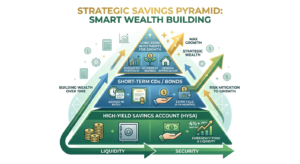
If you have a fully-funded 6-month emergency fund, consider this strategy: keep 3 months’ worth in your high-yield savings for immediate access, and put the other 3 months in a short-term CD or Treasury bill that pays even more.
This way you maintain liquidity for most emergencies while squeezing extra yield from money you’re very unlikely to need immediately.
Use Multiple High-Yield Accounts Strategically
There’s no rule saying you can only have one high-yield savings account. Consider using different accounts for different purposes:
- Emergency fund in one account
- Down payment savings in another
- Vacation fund in a third
This mental accounting helps you avoid dipping into your emergency fund for non-emergencies. Just make sure each account is at a different bank to maximize your FDIC coverage if you’re approaching $250,000 total savings.
Review Rates Quarterly
High-yield savings rates change frequently. Set a calendar reminder every three months to check whether your current account is still competitive. If rates have dropped significantly or a better option has emerged, don’t hesitate to move your money.
Loyalty doesn’t pay in the savings account world. Banks count on inertia—people who open an account and never look at it again even as rates drop. Don’t be that person.
Combine With Other Savings Strategies
Your high-yield savings account is the foundation, but combine it with other tactics:
- Build your initial emergency fund using our guide on how to build an emergency fund
- Create a budget that reveals money for savings using the 50/30/20 rule or zero-based budgeting
- Track spending to find extra dollars with our expense tracking guide
- Boost your savings rate with a side hustle if needed
Don’t Confuse Savings With Investing
High-yield savings accounts are for money you need to keep safe and accessible—emergency funds, short-term goals within 1-3 years, and cash reserves. They’re not for long-term wealth building.
Once you have your emergency fund fully funded, additional money should go toward investing for retirement and long-term goals. The stock market historically returns far more than any savings account, but it comes with risk and volatility that makes it wrong for emergency money.
Frequently Asked Questions About High-Yield Savings Accounts
Are high-yield savings accounts safe?
Yes, as long as they’re FDIC-insured (banks) or NCUA-insured (credit unions). This insurance protects your deposits up to $250,000 per depositor, per institution, even if the bank fails. Every account on our list carries this protection, making them exactly as safe as traditional banks—just more profitable for you.
Can I lose money in a high-yield savings account?
No, you cannot lose your principal in an FDIC or NCUA insured account (up to $250,000). The only way your account balance goes down is if you withdraw money. Your savings will only grow through deposits and earned interest.
How much money should I keep in a high-yield savings account?
Keep your full emergency fund (3-6 months of expenses) in a high-yield savings account, along with money for short-term goals you’ll need within 1-3 years. Beyond that, you’re better off investing for higher long-term returns. Our emergency fund guide helps you calculate your ideal amount.
What’s the difference between APY and interest rate?
APY (annual percentage yield) includes the effect of compounding, while a simple interest rate doesn’t. APY is the number to focus on because it represents what you’ll actually earn. For example, 4.00% APY compounded monthly earns you more than a simple 4.00% annual interest rate.
Are high-yield savings account earnings taxable?
Yes. Interest earned in savings accounts is taxable income. You’ll receive a 1099-INT form from your bank if you earn more than $10 in interest during the year, and you must report it on your tax return. This is true whether it’s a traditional savings account or high-yield—earned interest is always taxable.
Can I have multiple high-yield savings accounts?
Absolutely. There’s no limit to how many accounts you can have, and it can actually be smart to spread money across different banks for mental accounting (separating emergency funds from goal-specific savings) and to maximize FDIC coverage beyond $250,000.
How often do high-yield savings account rates change?
Rates can change frequently, sometimes monthly or even more often depending on broader economic conditions and what the Federal Reserve does. Most banks can adjust rates at any time, which is why it’s worth checking rates quarterly to make sure yours remains competitive.
Why do online banks pay so much more than traditional banks?
Lower overhead. Without physical branches, real estate costs, tellers, and branch managers, online banks operate far more efficiently. They pass these savings to customers through higher interest rates and lower fees. It’s a sustainable business model difference, not a gimmick.
What’s the catch with high-yield savings accounts?
There isn’t one, really. The “tradeoffs” are:
- Online-only access (no physical branches)
- Transfers take 1-3 days instead of being instant
- Less name recognition for some banks
For most people, these aren’t true drawbacks—especially when the payoff is earning 10x more interest. If you truly need in-person banking, consider Capital One 360, which offers both high-yield rates and physical café locations.
Should I move my emergency fund to a high-yield account?
Yes, absolutely. There’s no rational reason to keep your emergency fund in an account earning 0.01% when you could earn 4%+ with the same safety and similar liquidity. The only exception is if you anticipate needing the money within the next few days and can’t wait 1-3 days for a transfer to complete.
Common Mistakes to Avoid With High-Yield Savings Accounts
Don’t sabotage your savings with these common errors.
Mistake 1: Chasing Promotional Rates Without Reading Fine Print
Some banks offer eye-popping promotional rates like 5% or 6% APY to attract new customers. Read carefully—these rates are often:
- Temporary (reverts to much lower rate after 3-6 months)
- Only on balances up to a certain amount (like first $1,000)
- Requiring specific activities to maintain
Make sure you understand what the rate will be after the promotion ends.
Mistake 2: Picking a Rate and Never Checking Again
You did the hard work of researching and opening a high-yield account—don’t stop there. Banks frequently adjust rates, and what was competitive six months ago might now be lagging. Check your rate quarterly and be willing to move money if significantly better options emerge.
Mistake 3: Keeping Too Much in Savings
While high-yield savings accounts beat traditional accounts by a mile, they still lose to long-term investing. Once you have your 3-6 month emergency fund fully funded, additional money should go toward retirement accounts and investments that historically return 7-10% annually over time instead of 4%.
Mistake 4: Not Understanding FDIC Limits
FDIC insurance covers $250,000 per depositor, per insured bank, per ownership category. If you have more than $250,000 to save, spread it across multiple banks to maintain full protection. Having $500,000 in one bank account means $250,000 is uninsured.
Mistake 5: Using Savings for Non-Emergencies
Your high-yield savings account should be for actual savings—emergency funds, house down payments, or other significant goals. Don’t link it as overdraft protection or treat it as an extension of your checking account. Keep your spending money and saving money completely separate.
Conclusion: Start Earning What Your Savings Deserve Today
At this point, the choice is simple and the math is undeniable. You can keep your hard-earned savings in a traditional bank account earning pennies while inflation quietly erodes its value, or you can move it to a high-yield savings account and earn 10 to 20 times more with the same safety and similar access.
On a $10,000 emergency fund—a balance many people work years to accumulate—the difference between 0.38% and 4.00% is $362 per year. Over five years, that’s more than $1,800 in extra earnings for doing absolutely nothing except choosing the right account. That’s not theoretical—it’s real money you’re leaving on the table every single month you delay.
The accounts on this list make the choice easy. Whether you prioritize the absolute highest APY (Elevault at 4.34%), want brand recognition you trust (American Express or Marcus at 4.00%), or need a full banking relationship (SoFi or Ally around 3.90-4.00%), there’s an account that fits your specific needs.
Opening a high-yield savings account takes less than 15 minutes. You’ll need basic information, a funding source, and the willingness to finally stop subsidizing your traditional bank’s profits while your savings stagnate.
Your money should work as hard as you do. Stop letting it sit idle. Pick an account from this list, open it today, and start earning what your savings actually deserve.
Ready to maximize your savings? Start by building a fully-funded safety net with our guide on how to build an emergency fund, create a budget that reveals money to save using the 50/30/20 rule or zero-based budgeting, and learn how to automate your finances so your savings grow without requiring ongoing willpower. If you need to accelerate your progress, explore our side hustle ideas that pay $500+ per month. And once you hit your initial savings goal, challenge yourself with our guide on how to save $10,000 in one year. Your financial future starts with the account you choose today.
Disclaimer: This article is for informational purposes only and does not constitute financial advice. APY rates mentioned were accurate as of August 2026 and change frequently. Always verify current rates and terms directly with financial institutions before opening an account. FDIC insurance covers up to $250,000 per depositor, per insured bank, for each account ownership category.