

Introduction
You’ve done the hard work of building up some savings. Maybe it’s your emergency fund that you’ve been carefully growing month by month, or perhaps it’s money earmarked for a down payment on a house. Now you face a question that sounds simple but turns out to be surprisingly complicated: where exactly should you keep this money?
The answer used to be straightforward—you put it in a savings account and called it a day. But today’s financial landscape offers more options, and one alternative keeps coming up in every financial advice article you read: money market accounts.
Here’s where the confusion starts. Money market accounts and savings accounts sound similar, they’re both FDIC-insured, they both earn interest, and they’re both considered safe places for your cash. So what’s actually different? And more importantly, which one is better for your specific situation?
The truth is, while these two account types share similarities, they have meaningful differences in how they work, what they offer, and who they’re best suited for. Choosing the wrong one won’t necessarily harm you financially, but choosing the right one could earn you more interest, give you more flexibility, or better match your actual needs.
https://finance4you.online/student-loan-forgiveness-guide/
In this comprehensive guide, I’ll break down exactly what money market accounts and savings accounts are, how they differ across every factor that matters—rates, fees, access, minimums, and features—and most importantly, help you decide which account type deserves to hold your hard-earned money. By the end, you’ll have complete clarity on where your savings should live.
Let’s dive in.
What Is a Savings Account?
Before we can compare, we need clear definitions. Let’s start with the account type you’re probably already familiar with.
The Basic Definition
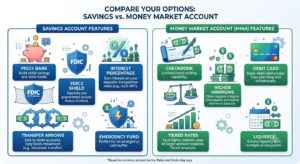
A savings account is a deposit account held at a bank or credit union that pays interest on your balance. It’s designed specifically for storing money you don’t need immediate access to, helping you save for goals or emergencies while earning a modest return.
Traditional savings accounts at brick-and-mortar banks typically pay very low interest rates—often around 0.01% to 0.50% APY. However, high-yield savings accounts offered primarily by online banks can pay significantly more, currently ranging from 3.50% to 4.50% APY as of 2026.
How Savings Accounts Work
The mechanics are beautifully simple. You deposit money into the account, and the bank pays you interest on that balance. Interest typically compounds daily or monthly and is calculated as an annual percentage yield (APY). You can withdraw money when needed, though there may be limits on certain types of withdrawals.
Most savings accounts have minimal requirements. Many online high-yield accounts require no minimum deposit to open and no minimum balance to maintain, though traditional banks often require $25 to $100 minimums.
Key Features of Savings Accounts
Safety: FDIC-insured up to $250,000 per depositor, per bank, making your money completely safe even if the bank fails.
Liquidity: Your money remains accessible. You can typically transfer funds to your checking account within 1-3 business days.
Interest earnings: You earn interest on your entire balance, with rates varying dramatically between traditional banks and high-yield options.
Simplicity: Savings accounts are straightforward with no complicated features or requirements.
If you’re building an emergency fund from scratch, a high-yield savings account is typically the recommended starting point. Our complete guide on how to build an emergency fund walks through exactly why savings accounts work so well for this purpose.
What Is a Money Market Account?
Now let’s tackle the less familiar option that often confuses people.
The Basic Definition
A money market account (MMA) is a type of savings account that typically offers higher interest rates in exchange for higher minimum balance requirements. What makes MMAs unique is that they combine features of both savings and checking accounts—you earn savings-account-level interest while also getting limited check-writing and debit card access.
The name confuses people because money market accounts are often conflated with money market funds (mutual funds that invest in short-term debt securities). They’re completely different products. We’re talking about money market accounts—deposit accounts at banks and credit unions that are FDIC or NCUA insured.
How Money Market Accounts Work
Like savings accounts, MMAs pay interest on your balance—often at competitive rates similar to or slightly higher than high-yield savings accounts. The key difference is the access: many MMAs come with a checkbook and/or a debit card, allowing you to write checks or make purchases directly from the account.
This hybrid nature makes MMAs appealing for people who want the interest earnings of a savings account but occasionally need faster access to their money without transferring to a checking account first.
Key Features of Money Market Accounts
Safety: Just like savings accounts, MMAs are FDIC-insured (banks) or NCUA-insured (credit unions) up to $250,000.
Higher minimums: Most MMAs require $1,000 to $10,000 to open and maintain, though some online banks have lowered or eliminated these requirements.
Check and debit access: Many MMAs include limited check-writing privileges (typically 6-10 checks per month) and a debit card for ATM withdrawals or purchases.
Tiered interest rates: Some MMAs pay higher rates on larger balances, rewarding savers with more money.
Competitive rates: Money market accounts often offer rates comparable to high-yield savings accounts, currently ranging from 3.50% to 4.50% APY.
Money Market Account vs Savings Account: Head-to-Head Comparison
Now that we understand what each account type is, let’s compare them across every factor that actually matters to you.
Interest Rates: Who Pays More?
This is usually the first question everyone asks, and the answer might surprise you.
The short answer: It depends, but the gap has narrowed significantly in recent years.
Historically, money market accounts paid noticeably higher rates than savings accounts as a reward for maintaining higher balances. But the rise of high-yield savings accounts from online banks has changed the game completely.
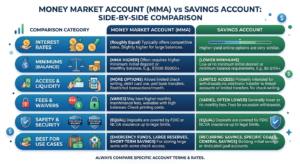
As of 2026, top high-yield savings accounts pay 3.90% to 4.50% APY, while competitive money market accounts pay roughly the same range. In many cases, you’ll find identical rates between the two account types at the same institution.
The exception is tiered MMAs, which pay progressively higher rates as your balance grows. For example, you might earn 3.50% on balances under $10,000 but 4.25% on balances above $50,000. If you have a substantial balance, these tiers can make MMAs more lucrative.
Bottom line: For most savers with typical balances, interest rates are now essentially equal between competitive high-yield savings accounts and money market accounts. Choose based on other factors rather than rate alone.
Minimum Balance Requirements: The Accessibility Factor
This is where savings accounts and money market accounts diverge most clearly.
Savings accounts: Many high-yield savings accounts, especially from online banks, require $0 to open and $0 minimum ongoing balance. You can literally open an account with $1 and start earning the full advertised APY immediately.
Money market accounts: Most require $1,000 to $10,000 minimum to open, and many require you to maintain that balance to avoid monthly fees or earn the advertised rate. Some banks charge fees if your balance drops below the minimum, while others simply stop paying interest or reduce your rate.
This difference makes savings accounts far more accessible for people just starting to build their emergency fund. If you only have $500 saved, most MMAs won’t even let you open an account, while plenty of excellent savings accounts will welcome you with open arms.
The exception: Some online banks now offer money market accounts with $0 minimums to compete with savings accounts. These blur the line between the two account types considerably.
https://finance4you.online/money-market-account-vs-savings-account/
Access to Your Money: Convenience and Flexibility
How easily can you actually use your money when you need it? This is where money market accounts potentially shine.
Savings accounts: You can access your money through:
- Electronic transfers to linked checking accounts (typically 1-3 business days)
- Mobile app transfers
- Wire transfers (often with fees)
- In-person withdrawals at branch (for traditional banks)
You generally cannot write checks from a savings account or use a debit card directly connected to it. To spend the money, you must first transfer it to a checking account.
Money market accounts: You get everything a savings account offers, plus:
- Check-writing privileges (typically 6-10 checks per month)
- Debit card for ATM withdrawals and purchases
- Faster access without the intermediate transfer step
This extra access is valuable if you keep a larger cash cushion and occasionally need to access it quickly. For example, if a major car repair costs $2,000 and the shop only takes checks, you can write one directly from your MMA rather than waiting 1-3 days for a transfer from savings to checking to clear.
However, there’s a catch: federal regulation limits certain types of withdrawals from both savings accounts and money market accounts to six per month. Exceed this limit repeatedly, and your bank may convert your account to a checking account or close it entirely.
Bottom line: If you need occasional direct access without transfers, MMAs offer more convenience. If you’re fine with a 1-3 day transfer to checking, savings accounts work perfectly well.
Fees: What Will You Actually Pay?
Both account types can come with fees that eat into your earnings. Here’s what to watch for.
Common fees for both:
- Monthly maintenance fees (often $5-15/month)
- Excessive transaction fees if you exceed withdrawal limits
- Wire transfer fees
- Returned item fees
- Account closure fees
How to avoid them: The best high-yield savings accounts and money market accounts from online banks typically charge $0 monthly maintenance fees regardless of your balance. Traditional banks often charge monthly fees unless you maintain a minimum balance.
Money market accounts are more likely to charge fees if you fall below the minimum balance requirement—sometimes $10-15 per month, which can quickly erase any interest you earned.
Bottom line: Choose accounts with no monthly fees, or at minimum, ensure you can reliably meet the requirements to waive them. Check out our comparison of the best high-yield savings accounts to see which options charge zero fees.
Safety and Insurance: How Protected Is Your Money?
This is the easy one—both account types are equally safe.
FDIC insurance covers both savings accounts and money market accounts at banks up to $250,000 per depositor, per insured bank, for each account ownership category. NCUA insurance provides identical coverage at credit unions.
This means your money is protected even if the institution fails completely. The government guarantees you’ll get your money back up to the coverage limits.
There is absolutely no safety difference between the two account types. Both are among the safest places you can keep money, period.
Bottom line: Safety is equal. Choose based on other factors.
https://finance4you.online/save-10000-in-one-year/
The Pros and Cons: Quick Reference
Let’s summarize the advantages and disadvantages of each account type.
Savings Account Pros
- Often no minimum deposit required
- No minimum balance to maintain or earn interest
- Simple and straightforward to understand
- Usually no monthly fees (especially online accounts)
- Perfect for building emergency funds from zero
- Easy to open and manage
Savings Account Cons
- No check-writing or debit card access
- Must transfer to checking to spend money (1-3 day wait)
- Traditional banks pay very low rates (online banks solve this)
- Limited direct access compared to MMAs
Money Market Account Pros
- Check-writing privileges for easier access
- Debit card for ATM withdrawals and purchases
- Often tiered rates that reward higher balances
- Competitive interest rates similar to high-yield savings
- Combines features of savings and checking
- Good for larger emergency funds that occasionally need quick access
Money Market Account Cons
- Higher minimum deposits (often $1,000-$10,000)
- Minimum balance requirements to avoid fees
- More complex than simple savings accounts
- Monthly fees if balance drops below minimum
- Not accessible for people just starting to save
- Still subject to six-withdrawal-per-month federal limit
Which Account Type Is Right for You?
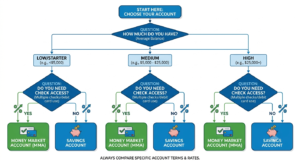
The “better” account depends entirely on your situation. Here’s how to decide.
Choose a High-Yield Savings Account If…
You’re just starting to build savings and have less than $1,000. Savings accounts with zero minimums let you start immediately with whatever you have.
You want the absolute simplest option with no complications. Savings accounts are straightforward—deposit money, earn interest, done.
You don’t need check-writing or debit card access to your emergency fund. If you’re comfortable with transferring money to checking when needed, savings accounts work perfectly.
You want to avoid any risk of monthly fees. Many high-yield savings accounts charge zero fees regardless of balance.
You’re building an emergency fund and want to keep it mentally separate from spending money. The lack of direct access helps prevent you from dipping into savings for non-emergencies.
Choose a Money Market Account If…
You have at least $1,000 to $10,000 to deposit and can comfortably maintain that balance. MMAs reward larger balances, so having a substantial amount makes sense.
You want occasional direct access through checks or debit card. If you keep a larger cash cushion and sometimes need it quickly, the convenience is valuable.
You have a large emergency fund and want tiered rates. If you’re keeping $25,000+ in cash, tiered MMAs may pay more on higher balances.
You want to consolidate accounts. Some people use an MMA as both their primary savings and their emergency checking, reducing the number of accounts to manage.
You’re comfortable with minimum balance requirements and won’t be tempted to drop below them.
The Hybrid Approach: Use Both
There’s no rule saying you must choose just one. Many people use both strategically:
Example strategy: Keep your 3-month emergency fund in a money market account with check and debit access for quick emergencies. Keep additional savings for goals (vacation, down payment, car fund) in separate high-yield savings accounts organized by purpose.
This gives you the best of both worlds—quick access to emergency money and separate, mentally-accounted savings for specific goals.
Best Money Market Accounts in 2026 (Quick Overview)
If you’ve decided a money market account is right for you, here are some top options currently available.
High-Yield Money Market Accounts With No Minimums
Several online banks now offer MMAs that eliminate the traditional barrier of high minimums:
Quontic Bank Money Market Account — Offers competitive rates with $0 minimum and includes a debit card for easy access.
Sallie Mae Money Market Account — Pays strong APY with no minimum balance requirement and no monthly fees.
Vio Bank Cornerstone Money Market Account — Competitive rate with relatively low minimums compared to traditional banks.
Traditional Money Market Accounts With Higher Minimums
If you have a larger balance, these accounts offer competitive rates:
CIT Bank Money Market Account — Requires $100 minimum, pays tiered rates that increase with balance size.
Discover Money Market Account — Well-known brand, competitive rates, includes check-writing and debit card access.
For detailed rate comparisons and current APYs, check out our comprehensive guide on high-yield savings accounts, which includes money market account comparisons.
Common Misconceptions About Money Market Accounts
Let’s clear up some confusion that leads people astray.
Misconception 1: Money Market Accounts Are the Same as Money Market Funds
This is the most common mix-up. Money market accounts are FDIC-insured bank accounts—your deposits are guaranteed safe up to $250,000. Money market mutual funds are investment products that buy short-term debt securities—they’re not FDIC-insured and can theoretically lose value.
When we’re discussing where to keep emergency funds, we’re talking about money market accounts (safe, insured), never money market funds (investment products).
Misconception 2: MMAs Always Pay Higher Rates Than Savings Accounts
This used to be true but isn’t anymore. High-yield savings accounts from online banks now match or sometimes exceed money market account rates. Always compare current rates rather than assuming MMAs automatically pay more.
Misconception 3: You Can Write Unlimited Checks From an MMA
No—money market accounts are still subject to federal withdrawal limits. You can typically write 6-10 checks per month before facing fees or restrictions. If you need unlimited check-writing, you need a checking account, not an MMA.
Misconception 4: Money Market Accounts Are Only for Wealthy People
While MMAs traditionally required high minimums, that’s changing. Several online banks now offer MMAs with $0 minimums, making them accessible to anyone. Don’t rule them out based on outdated assumptions.
Maximizing Your Returns: Whichever Account You Choose
Regardless of whether you choose a savings account or money market account, these strategies help you earn more.
Shop for the Highest Rate
Rates vary dramatically between banks. The national average savings rate sits around 0.38%, while top accounts pay 4.00%+ APY. That’s literally 10 times more earnings on the same money. Always compare before opening an account.
Automate Your Deposits
The best way to build savings is to make it automatic. Set up recurring transfers from checking to your savings or MMA the day after each paycheck hits. Treat savings like a bill that must be paid. Our guide on how to automate your finances shows you exactly how to set this up.
Review Rates Quarterly
Banks change rates frequently, especially when the Federal Reserve adjusts interest rates. Set a calendar reminder every three months to check whether your current account remains competitive. If you’re earning 2% while competitors pay 4%, it’s time to move your money.
Avoid Fees Like the Plague
A $10 monthly fee on a $5,000 balance earning 4% APY ($200/year) consumes 60% of your interest earnings. Choose accounts with zero fees or ensure you can reliably meet requirements to waive them.
Use Your Savings Strategically
Keep 3-6 months of expenses in your savings or MMA for emergencies, but don’t let excess cash sit indefinitely earning 4% when you could invest it for potentially 8-10% annual returns over the long term. Once your emergency fund is fully funded, redirect additional savings to retirement and investment accounts.
Consider a CD Ladder for Larger Amounts
If you have a fully-funded emergency fund and additional savings you won’t need for a while, consider putting part of it in CDs (certificates of deposit) which typically pay higher rates in exchange for locking up money for a set term. A CD ladder strategy maintains some liquidity while maximizing returns.
How to Switch Accounts (If You Decide to Move)
Already have a savings account but think a money market account would serve you better (or vice versa)? Here’s how to make the switch smoothly.
Step 1: Research and Choose Your New Account
Compare current offerings using the criteria we discussed—rates, fees, minimums, access features. Don’t rush this decision just because you’re excited to switch.
Step 2: Open the New Account
Complete the online application for your new savings or money market account. You’ll typically need your Social Security number, ID, and information about your current bank to link accounts.
Step 3: Start Small
Initially transfer a small amount (like $100) to test the system and ensure everything works correctly. Verify the money arrives, check that you can access the account, and familiarize yourself with the interface.
Step 4: Redirect Automatic Deposits
If you have automatic transfers going to your old account, redirect them to the new one. This ensures your savings continue building in the new account going forward.
Step 5: Transfer the Full Balance
Once you’re comfortable the new account works correctly, transfer your full balance from the old account to the new one. This typically takes 1-3 business days via ACH transfer.
Step 6: Close the Old Account (Maybe)
Consider keeping your old account open with a minimal balance for a month to catch any lingering automatic transfers you might have forgotten about. Once you’re certain everything has moved, you can close it completely.
Step 7: Update Your Records
If you’ve linked your savings or MMA to budgeting apps, update them with your new account information. If you use it for bill pay or have given the account number to anyone for direct deposit, update those records as well.
Frequently Asked Questions
Can I have both a savings account and a money market account?
Absolutely. Many people maintain both—perhaps a money market account for their emergency fund (with check/debit access) and separate high-yield savings accounts for specific goals like vacation or down payment savings. There’s no limit on how many accounts you can have.
Which earns more interest: savings or money market?
As of 2026, competitive high-yield savings accounts and money market accounts pay essentially the same rates—both ranging from 3.50% to 4.50% APY. Some MMAs offer tiered rates that pay slightly more on higher balances, but for most typical balances, rates are comparable. Always compare current rates rather than assuming one type pays more.
Are money market accounts worth it if I only have $1,000?
It depends. If the MMA requires exactly $1,000 minimum and you have exactly $1,000, you’re cutting it close—any dip below the minimum could trigger fees. A high-yield savings account with $0 minimum gives you more flexibility. However, if you comfortably have $2,000+ and want check/debit access, an MMA can work even at that level.
Can I lose money in a savings or money market account?
No, you cannot lose your principal in an FDIC or NCUA insured account (up to $250,000). Both savings accounts and MMAs are among the safest places to keep money. Your balance only decreases if you withdraw funds. The only “loss” is that interest rates below inflation mean your purchasing power slowly erodes over time—but that’s true of any cash savings.
Should I use a money market account for my emergency fund?
Many people do, especially if they have a larger emergency fund ($10,000+) and appreciate the convenience of check-writing and debit card access. The ability to write a check for an emergency expense without waiting for a transfer can be valuable. However, a high-yield savings account works equally well if you don’t need that direct access. For guidance on building your fund, see our complete guide on how to build an emergency fund.
What happens if I exceed the withdrawal limit?
Federal regulation historically limited certain withdrawals from both savings and MMAs to six per month. If you exceed this repeatedly, your bank may charge fees (often $5-10 per excess transaction), convert your account to a checking account, or close the account entirely. During emergencies, this regulation has been relaxed, but many banks still enforce it. Check your specific bank’s policy.
Do I pay taxes on money market and savings account interest?
Yes. Interest earned in both account types is taxable income. If you earn more than $10 in interest during the year, your bank will send you a 1099-INT form, and you must report it on your tax return. This is true whether it’s $40 in interest or $4,000—all interest income is taxable at your ordinary income tax rate.
Conclusion: The Right Account Is the One That Fits Your Life
After reading thousands of words comparing money market accounts and savings accounts, here’s the truth that matters most: both are excellent, safe places to keep your emergency fund and short-term savings. The differences between them—while real—are far less important than the difference between using either one versus leaving money in a checking account earning nothing.
For most people just starting to build an emergency fund, a high-yield savings account is the perfect choice. Zero minimums, simple structure, competitive rates, and complete safety make it accessible and effective. You can start with $50 and immediately begin earning 4%+ APY while building toward your goal.
For those with established emergency funds of $5,000, $10,000, or more who value the convenience of writing checks or using a debit card for occasional direct access, money market accounts offer that flexibility without sacrificing rate or safety.
And for many people, using both strategically—an MMA for immediate emergencies, savings accounts for specific goals—provides the best combination of access and organization.
The bottom line: stop overthinking it. Choose the account type that matches your balance and access needs, make sure it’s paying a competitive rate (4%+ as of 2026), verify it has $0 monthly fees, and then actually open it. The difference between a savings account and a money market account is negligible. The difference between either one and doing nothing is massive.
Ready to put your money in the right place? Build your emergency fund foundation with our guide on how to build an emergency fund, compare the top-paying accounts in our high-yield savings account comparison, set up automation so your savings grow effortlessly with how to automate your finances, and create a budget that reveals money to save using the 50/30/20 rule or zero-based budgeting. Your savings deserve to work as hard as you do—give them the right home today.
Disclaimer: This article is for informational purposes only and does not constitute financial advice. Interest rates and account features change frequently. Always verify current terms and rates directly with financial institutions before opening an account. FDIC insurance covers up to $250,000 per depositor, per insured bank, for each account ownership category.