

Introduction
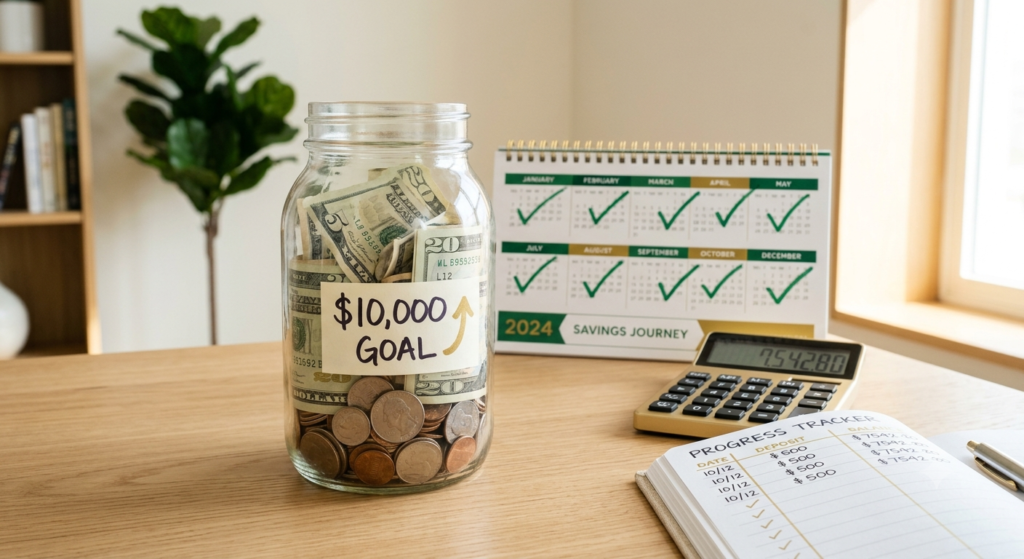
Saving $10,000 in one year sounds intimidating at first. For many people, it feels like the kind of goal only high-income earners can reach. But when you break it down, $10,000 is not one giant impossible number—it is a series of smaller, manageable steps.
To save $10,000 in 12 months, you need to save about $834 per month, $193 per week, or roughly $27.40 per day. That is still a serious goal, but it suddenly becomes easier to understand. Instead of asking, “How can I magically find $10,000?” you start asking, “How can I free up or earn an extra $27 per day?”
That shift changes everything.
The truth is, saving $10,000 in a year usually requires a combination of three things: better budgeting, intentional spending cuts, and extra income. You do not need to live miserably or cut every joy from your life, but you do need a clear plan and consistent action.
In this guide, you will learn exactly how to save $10,000 in one year using a realistic 12-month action plan. We will break down the numbers, build a savings system, find money in your current budget, explore income-boosting ideas, and create habits that help you stay consistent even when motivation fades.https://finance4you.online/student-loan-forgiveness-guide/
By the end, you will have a practical roadmap to turn a big savings dream into a real bank balance.
How Much Do You Need to Save to Reach $10,000?
Before you start cutting expenses or opening new accounts, you need to understand the math. A clear savings target removes confusion and gives you something concrete to track.
Here is what saving $10,000 in one year looks like:
| Timeframe | Amount to Save |
|---|---|
| Per year | $10,000 |
| Per month | $833.33 |
| Per week | $192.31 |
| Per day | $27.40 |
At first glance, $833 per month may feel overwhelming. But remember, you do not have to find that money from one place. You might save $300 by cutting expenses, earn $400 from a side hustle, and redirect $133 from subscriptions, refunds, or reduced impulse spending.
The goal is not perfection. The goal is progress.
Choose the Savings Pace That Fits Your Life
There are three common ways to approach this challenge:
1. Equal monthly savings
You save $833 every month for 12 months. This is simple and predictable.
2. Gradual increase method
You start smaller and increase your savings each month as your confidence grows. This is helpful if your budget is tight now but you expect to improve your income or spending habits.
3. Front-loaded savings method
You save aggressively early in the year when motivation is high, then reduce the pressure later. This works well if you expect a tax refund, bonus, or seasonal income.
There is no single right method. The best savings plan is the one you can actually follow.
Step 1: Define Why You Want to Save $10,000
Saving money is easier when the goal has meaning. If your only reason is “I should save more,” you will probably lose motivation after a few weeks. But if your goal is tied to something personal, you are much more likely to stay committed.
Ask yourself: What will $10,000 do for my life?
Maybe it will:
- Build a full emergency fund
- Help you move out or relocate
- Pay for a reliable used car
- Start a home down payment fund
- Pay off high-interest debt
- Fund a business idea
- Create peace of mind
- Cover maternity leave or medical expenses
- Give you the confidence to leave a stressful job
Write your reason down. Put it somewhere visible—on your phone wallpaper, inside your planner, or on a sticky note near your desk. When temptation hits, your “why” will remind you what you are really working toward.
If your main goal is safety and stability, start with our guide on 1. That article explains how to decide whether $10,000 is the right emergency fund number for your situation.
Step 2: Open a Separate High-Yield Savings Account
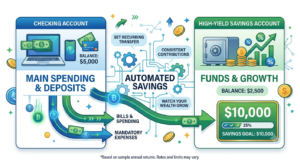
One of the biggest mistakes people make is trying to save money in the same checking account they use for everyday spending. That rarely works because the money feels available. If it is sitting next to your grocery, gas, and bill money, it becomes too easy to spend.
Instead, open a separate savings account specifically for your $10,000 goal.
Why Separation Matters
A separate account creates a mental boundary. The money is no longer “extra cash.” It belongs to your savings goal. This simple separation reduces the temptation to dip into it for non-emergencies.
Even better, use a high-yield savings account so your money earns interest while you build your balance. A traditional savings account may pay almost nothing, while competitive online savings accounts often offer much better rates.
For current options, read our comparison of the 1. If you are deciding between a savings account and a money market account, our guide on 1 can help you choose the best place to keep your money.
What to Look For in the Account
Choose an account with:
- No monthly maintenance fees
- No minimum balance requirement
- FDIC or NCUA insurance
- Easy transfers from your checking account
- A competitive APY
- A mobile app that makes tracking simple
Do not overcomplicate this step. The account does not need to be perfect. It just needs to be safe, separate, and easy to use.
Step 3: Build Your Monthly $833 Savings Plan
Now it is time to decide exactly where the money will come from. Saving $10,000 in one year requires a monthly plan, not vague hope.
Your target is:
$833 per month x 12 months = $9,996
Add an extra $4 at any point and you are at $10,000.
Example Monthly Savings Breakdown
Here is one realistic way to build your $833 monthly savings:
| Source | Monthly Amount |
|---|---|
| Reduce dining out | $150 |
| Cancel unused subscriptions | $50 |
| Lower grocery spending | $100 |
| Reduce shopping/impulse buys | $125 |
| Side hustle income | $300 |
| Automatic paycheck transfer | $108 |
| Total | $833 |
This example shows an important truth: you do not need to cut $833 from your current lifestyle. You can combine smaller cuts with extra income.
Create Your Own Savings Formula
Use this simple formula:
Monthly savings goal = spending cuts + extra income + automatic savings
For example:
- $250 from cutting expenses
- $400 from extra income
- $183 from automatic savings
Total: $833 per month
This flexible approach makes the goal more achievable, especially if your current budget does not have a lot of room.
https://finance4you.online/how-to-build-emergency-fund/
Step 4: Track Your Spending for 30 Days
Before you can save more, you need to know where your money is currently going. Most people do not have an income problem only—they also have a visibility problem. Money disappears because it is not being tracked.
For the next 30 days, track every dollar you spend. Not to shame yourself, but to collect data.
You can use:
- A budgeting app
- A spreadsheet
- A notebook
- Your bank statements
- A printable expense tracker
If you are not sure which method to use, follow our full guide on 1. It breaks down five simple methods so you can choose the one that fits your personality.
What to Look For
At the end of 30 days, review your spending and look for:
- Subscriptions you forgot about
- Dining out that added up faster than expected
- Grocery waste
- Impulse shopping
- Convenience purchases
- Bank fees
- Delivery fees
- Unused memberships
- Insurance or phone bills that could be lowered
You are not looking for one magical fix. You are looking for multiple small leaks. Plug enough leaks, and you can free up hundreds of dollars per month.
Step 5: Use a Budget That Supports the Goal
A savings goal without a budget is just a wish. If you want to save $10,000 in one year, your budget needs to make room for that goal every single month.
Two budgeting methods work especially well.
Option 1: The 50/30/20 Rule
The 1 divides your after-tax income into:
- 50% for needs
- 30% for wants
- 20% for savings and debt repayment
If your income is high enough, saving $833 per month may fit into the 20% savings category. For example, if your monthly take-home pay is around $4,200, then 20% equals $840—almost exactly your target.
This method is simple and flexible, making it great for beginners.
Option 2: Zero-Based Budgeting
If your budget is tight or you need more control, use 1. This method gives every dollar a job before the month begins.
With zero-based budgeting, your $833 savings goal becomes a non-negotiable line item, just like rent or utilities. Instead of saving whatever is left over, you decide in advance that saving comes first.
This method is more detailed, but it is extremely powerful for ambitious goals like saving $10,000.
Step 6: Automate Your Savings
Automation is one of the most important steps in this entire plan. If you rely on willpower, you will eventually skip a month. If you automate your savings, the money moves before you can spend it.
Set up an automatic transfer from your checking account to your savings account every payday.
For example:
- Paid weekly? Transfer $193 every payday.
- Paid biweekly? Transfer $385 every payday.
- Paid twice monthly? Transfer $417 each paycheck.
- Paid monthly? Transfer $833 once per month.
If $833 feels too aggressive at first, start with what you can and increase it every month. The key is to make saving automatic.
Our guide on 1 explains how to set up automatic transfers, bill payments, and savings systems so your financial goals run in the background.
Pay Yourself First
The phrase “pay yourself first” means saving before spending, not after. Most people do the opposite. They pay bills, spend throughout the month, and hope something remains for savings.
Usually, nothing remains.
Automating your savings flips the order. Your future gets paid first, and your lifestyle adjusts around what is left.
Step 7: Cut Expenses Without Feeling Miserable
Saving $10,000 does not mean you have to live like a monk. But it does mean you need to become intentional about spending.
The goal is not to eliminate joy. The goal is to stop wasting money on things that do not matter to you.
Start With Easy Cuts
Begin with expenses that cause little pain:
- Cancel unused subscriptions
- Switch to a cheaper phone plan
- Use your library instead of buying books
- Cook at home more often
- Cancel unused memberships
- Negotiate internet or insurance bills
- Stop paying bank fees
- Use cash-back apps carefully
- Buy generic brands
These cuts may not feel dramatic, but they add up.
Reduce Food Spending
Food is one of the easiest categories to improve because it includes both needs and wants.
Try:
- Meal planning once per week
- Shopping with a list
- Cooking double portions for leftovers
- Limiting takeout to one planned day per week
- Using grocery pickup to avoid impulse buys
- Eating what you already have before buying more
- Buying store brands
- Reducing food waste
Even saving $25 per week on food gives you $1,300 per year.
Try a Temporary Spending Freeze
A spending freeze means you stop buying non-essential items for a set period—usually 7, 14, or 30 days.
During the freeze, you still pay bills and buy essentials, but you pause:
- Clothes
- Decor
- Gadgets
- Takeout
- Entertainment purchases
- Beauty extras
- Random online shopping
A one-month spending freeze can give your $10,000 goal a serious jumpstart.
Use the “24-Hour Rule”
For any non-essential purchase, wait 24 hours before buying. For larger purchases, wait 7 days.
This simple habit reduces impulse spending dramatically. Many things that feel urgent in the moment become forgettable the next day.
https://finance4you.online/best-high-yield-savings-accounts/
Step 8: Increase Your Income
Cutting expenses is powerful, but earning extra income can make the $10,000 goal much easier. There is only so much you can cut, but there are many ways to earn more.
If you can earn an extra $300 to $500 per month, your savings goal becomes far more realistic.
Side Hustle Ideas
Consider:
- Freelance writing
- Virtual assistant work
- Tutoring
- Pet sitting or dog walking
- Babysitting
- Food delivery
- Rideshare driving
- Selling digital products
- Selling items online
- Cleaning services
- Weekend retail shifts
- Photography
- Social media management
- Handyman work
- Lawn care
- House sitting
For a full list of practical ideas, read our guide on 1.
Sell What You Do Not Use
Most homes have hundreds or even thousands of dollars sitting in unused items.
Look for:
- Old phones
- Electronics
- Furniture
- Clothes
- Shoes
- Baby gear
- Tools
- Exercise equipment
- Collectibles
- Books
- Kitchen appliances
Selling $1,000 worth of unused items immediately knocks out 10% of your goal.
Ask for More at Work
Do not ignore your main income source. You may be able to:
- Ask for a raise
- Work overtime
- Pick up extra shifts
- Apply for a promotion
- Switch departments
- Negotiate better benefits
- Find a higher-paying job
A $1 per hour raise equals about $2,000 per year for full-time workers before taxes. A $3 per hour raise can dramatically change your savings timeline.
Step 9: Use Windfalls Wisely
Windfalls are unexpected or irregular money. They can dramatically speed up your savings progress if you do not spend them immediately.
Examples include:
- Tax refunds
- Work bonuses
- Birthday money
- Holiday gifts
- Rebates
- Cash-back rewards
- Stimulus or relief payments
- Insurance refunds
- Overtime pay
- Commission checks
Create a rule before the money arrives.
For example:
- Put 80% of every windfall toward savings
- Use 10% for fun
- Use 10% for debt or giving
This allows you to enjoy some of the money while still making major progress.
If you receive a $2,000 tax refund and save 80%, that is $1,600 toward your goal—almost two full months of savings in one move.
Step 10: Track Your Progress Every Week
A year is a long time. If you only check your savings once every few months, you may drift off track without noticing. Weekly tracking keeps the goal alive.
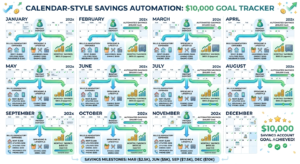
Create a simple savings tracker with 12 monthly milestones:
| Month | Target Balance |
|---|---|
| Month 1 | $833 |
| Month 2 | $1,666 |
| Month 3 | $2,499 |
| Month 4 | $3,332 |
| Month 5 | $4,165 |
| Month 6 | $4,998 |
| Month 7 | $5,831 |
| Month 8 | $6,664 |
| Month 9 | $7,497 |
| Month 10 | $8,330 |
| Month 11 | $9,163 |
| Month 12 | $10,000 |
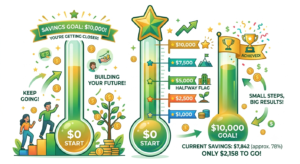
You can use a spreadsheet, printable tracker, budgeting app, or even a thermometer chart on your wall.
Celebrate Small Wins
Saving $10,000 requires endurance. Celebrate milestones:
- $1,000 saved
- $2,500 saved
- $5,000 saved
- $7,500 saved
- $10,000 saved
Keep celebrations low-cost, but meaningful. Motivation matters.
What If You Fall Behind?
You probably will fall behind at some point. That does not mean you failed. It means life happened.
Maybe your car needs repairs. Maybe your hours get cut. Maybe you have a medical bill. Maybe one month is simply more expensive than expected.
The key is to adjust, not quit.
Use a Catch-Up Plan
If you miss one month of $833 savings, you can recover by:
- Saving an extra $83 per month for the next 10 months
- Earning $200 extra for four months
- Doing a one-month spending freeze
- Selling unused items
- Using a windfall
- Temporarily reducing wants
Falling behind is not the problem. Giving up is the problem.
Recalculate the Goal if Needed
If $10,000 becomes unrealistic due to a major life event, adjust the target instead of abandoning the habit.
Maybe you save $7,000 this year instead. That is still a huge win. The habit matters more than hitting a perfect number.
How to Save $10,000 on a Low Income
Saving $10,000 on a low income is harder, but not impossible. It usually requires a longer timeline, more creativity, or stronger income growth.
Start With a Smaller Emergency Goal
If you do not have any savings, focus first on $500 or $1,000. This gives you a small cushion and prevents you from relying on credit cards for every surprise expense.
Then build toward $10,000 gradually.
Prioritize Income Growth
On a low income, cutting expenses can only go so far. The biggest opportunity is usually increasing income.
Focus on:
- Higher-paying jobs
- Certification programs
- Weekend work
- Freelancing
- Overtime
- Side hustles
- Selling unused items
- Government or community assistance if eligible
Reduce Your Biggest Expenses
Small cuts help, but big expenses move the needle faster.
Look at:
- Housing
- Transportation
- Food
- Insurance
- Debt payments
Could you get a roommate? Move to a cheaper apartment? Refinance or sell a costly vehicle? Use public transportation? Lower insurance premiums? These decisions are not easy, but they can free up hundreds per month.
Frequently Asked Questions
Is saving $10,000 in one year realistic?
Yes, but it depends on your income, expenses, and willingness to make changes. You need to save about $833 per month. For some people, that requires cutting expenses. For others, it requires earning extra income. Most people need a combination of both.
How much do I need to save per paycheck to reach $10,000?
If you are paid weekly, save about $193 per paycheck. If you are paid biweekly, save about $385 per paycheck. If you are paid twice per month, save about $417 per paycheck. If you are paid monthly, save about $833.
Where should I keep my $10,000 savings?
A high-yield savings account is usually the best choice because it keeps your money safe, liquid, and earning interest. A money market account can also work if you want check-writing or debit card access. Avoid investing money you may need within the next year.
Should I save $10,000 or pay off debt first?
If you have no emergency fund, save a starter fund of $500 to $1,000 first. Then focus on high-interest debt, especially credit cards. After that, build your savings toward $10,000. If your debt has a very low interest rate, you may decide to save and pay debt at the same time.
Can I save $10,000 without a side hustle?
Yes, if your income is high enough and you can free up $833 per month from your current budget. But if your budget is tight, a side hustle can make the goal much more achievable and reduce the amount you need to cut.
What is the easiest way to save $10,000?
The easiest way is to automate savings every payday, keep the money in a separate high-yield savings account, track your progress weekly, and combine spending cuts with extra income. Automation removes the need for constant willpower.
Conclusion: $10,000 Starts With the First Dollar
Saving $10,000 in one year is a big goal, but it is not an impossible one. When you break it down, it becomes $833 per month, $193 per week, or $27.40 per day. That still requires effort, but it is manageable when you have a real plan.
Start by defining your reason. Open a separate high-yield savings account. Track your spending. Build a budget that makes savings a priority. Automate your transfers. Cut expenses that do not matter, increase your income where possible, and use windfalls wisely.
Most importantly, do not quit when the plan gets messy. One difficult month does not erase your progress. Every dollar saved is proof that you are building financial strength.
A year from now, you could still be wishing you had started—or you could be looking at a $10,000 balance that you built one step at a time.
Ready to keep building your financial foundation? Start with 1, compare the 1, learn 1, and use the 1 or 1 to make your savings goal part of your monthly plan.
Your $10,000 goal begins with the next deposit.
Disclaimer: This article is for informational purposes only and does not constitute financial advice. Everyone’s financial situation is different. Consider speaking with a qualified financial professional before making major financial decisions.